Official website and visitor information
Follow the administration’s current bathing-day routes, designated river access and boat arrangements.
Prayagraj district · travel connections · Ministry of Tourism · Prayagraj destination plan and rail approaches · Prayagraj district · Magh Mela
One sacred name, different river landscapes
Saraswati carries several meanings in India’s sacred geography. Ancient Vedic hymns praise a river and divine presence; devotees at Prayagraj honour an unseen Saraswati at the Triveni Sangam; and visitors near Mana in Uttarakhand can see a mountain river bearing the name. These contexts deserve to be understood individually. A shared name does not establish that they form one continuous physical watercourse.
Saraswati in the Rigveda
Rigveda 7.95 praises Saraswati as a powerful, nourishing river and invokes her divine protection. Verse 2 describes her movement from the mountains towards the sea in Ralph T. H. Griffith’s translation. The hymn helps explain why Saraswati belongs to India’s sacred memory as more than a geographical feature: water sustains life, while the river is addressed with devotion.
This is a Vedic textual reference. It should not be treated as a modern survey of an agreed river route. Reading the hymn alongside geographical research allows the spiritual meaning and the historical questions to remain clear.
The ancient river: what research can tell us
Researchers study buried river channels, sediment sources and their ages across the Ghaggar–Hakra region of northwestern India and Pakistan. These ancient channels are physical evidence of changing drainage, but their relationship to the Saraswati of the texts remains debated.
Singh and colleagues (2017) identified a former Sutlej channel along the Ghaggar–Hakra course and concluded that the Sutlej had shifted away by about 8,000 years ago, before the main urban phase of the Indus civilisation. Their interpretation shows that settlements could occupy an abandoned river corridor without a large Himalayan river flowing beside them at that time.
Chatterjee and colleagues (2019) reported evidence for perennial flow during different periods, including approximately 9,000–4,500 years ago, which they linked to Sutlej distributaries. The studies differ in their reconstruction of timing and water supply. Neither a satellite image nor the discovery of an old channel, by itself, settles every question about the river named in the Vedas. Its exact ancient source, course and identification should therefore not be presented as universally established.
The visible Saraswati at Mana
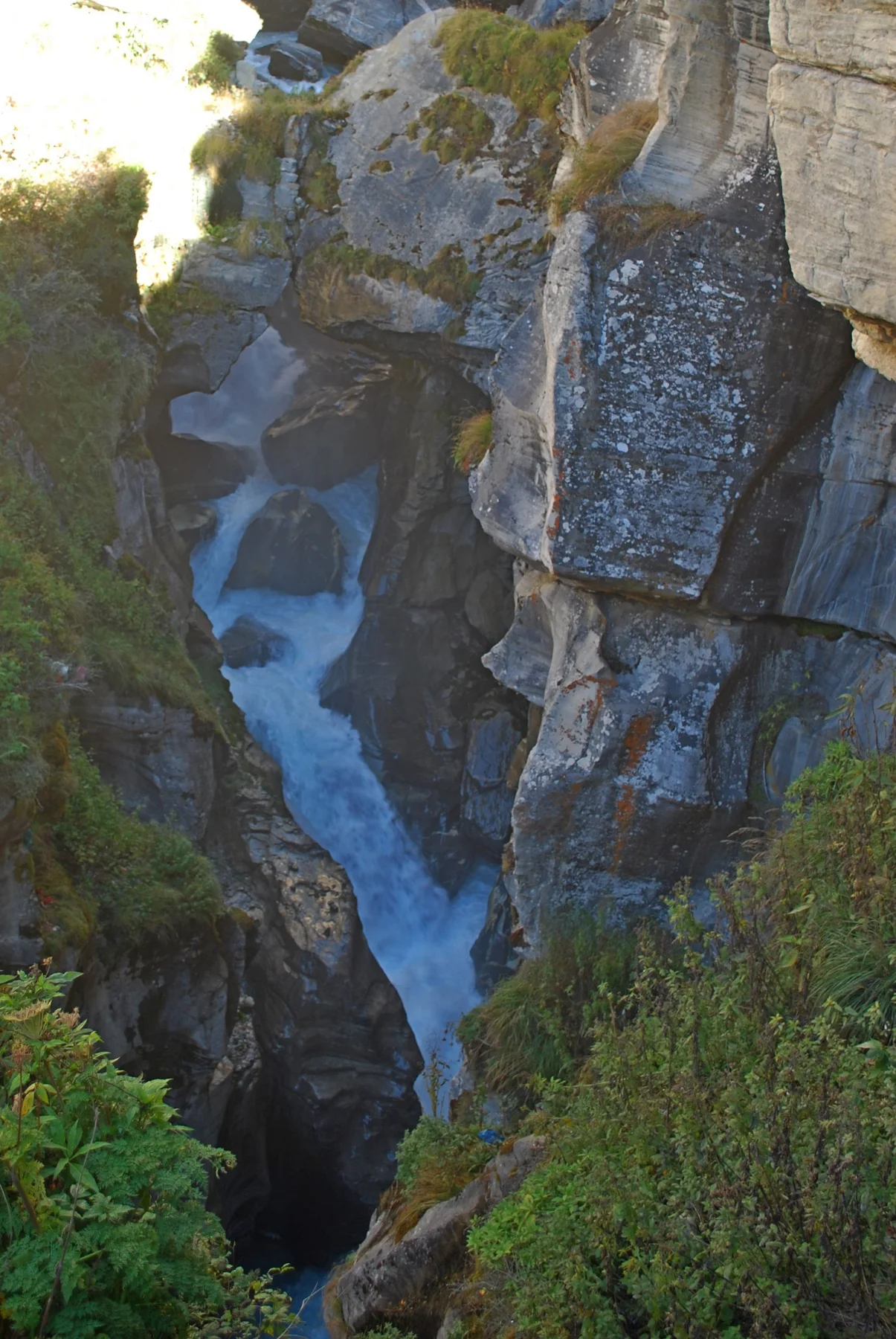
Near Mana, close to Badrinath in Uttarakhand, the Himalayan Saraswati rushes through a rocky gorge and belongs to the Alaknanda river system. Chamoli district’s geographical account lists it among the Alaknanda’s tributaries. This is a river visitors can see today; it is distinct from the disputed reconstruction of the ancient northwestern river.
Bheem Pul, a great rock bridge over this Saraswati, has its own local epic tradition. The Ministry of Tourism records the belief that Bhima helped the Pandavas cross by placing the rock. The story gives the landscape a Mahabharata association; it is presented here as a local tradition, not as a geological explanation or a claim that the bridge’s construction has been historically verified.
Continue exploring the region through the Ganga and its Himalayan prayags.
Prayagraj: the unseen river at the Sangam
At Prayagraj, the Ganga and Yamuna meet visibly. In sacred tradition, Saraswati joins them unseen, creating the Triveni Sangam, the meeting of three rivers. Prayagraj district describes this third river as mythical and records the belief that it flows underground. This devotional understanding should not be confused with a scientifically demonstrated underground connection from Mana or the Ghaggar–Hakra region.
The Sangam is associated with the annual Magh Mela and the larger Kumbh gatherings. Bathing, prayer and pilgrimage give the confluence its living significance. Read the Kumbh Mela guide for its mythology and traditions, and how festival dates are calculated for the calendar background. Confirm each year’s programme through official local information.
Official information, maps and further exploration
For Mana and Bheem Pul, consult the Ministry of Tourism’s Bheem Pul guide and Chamoli district for local notices. For the Sangam, use Prayagraj district’s official visitor information. Mountain access and river conditions can change; check local advice before travelling.
Google Maps: Saraswati at Bheem Pul, Mana · Triveni Sangam, Prayagraj.
Getting there
Prayagraj Sangam
- Local / nearest rail approach
- Prayagraj Sangam railway station
- Major long-distance railway option
- Prayagraj Junction
- Nearest airport / regional flight gateway
- Prayagraj Airport (IXD)
Prayagraj Sangam is a local approach; compare long-distance trains at Prayagraj Junction. Festival traffic plans can alter the permitted arrival route.
Travel source: Prayagraj district · travel connections · Ministry of Tourism · Prayagraj destination plan and rail approaches · Prayagraj district · Magh Mela
Prayagraj district · travel connections
Best time to visit
Winter is the principal pilgrimage period for the annual Magh Mela, usually January–February. Outside festival dates, choose the cooler part of the year; summer riverbank visits can be very hot.
Festivals & occasions: The annual Magh Mela follows the Hindu month of Magh. Kumbh editions are separately announced; do not assume a Kumbh takes place every year.
Season & festival references: Prayagraj district · travel connections · Ministry of Tourism · Prayagraj destination plan and rail approaches · Prayagraj district · Magh Mela
Reviewed 21 November 2026. Seasonal windows are guidance; confirm weather, access and the current event programme before booking.
Arrival points apply to the named approach. A gateway is a practical travel option, not a claim that it is the closest stop. Confirm passenger services and the onward transfer before booking.
Sources & further reading
Read the evidence and traditions behind this guide.
- Rigveda 7.95 · Sarasvati, translated by Ralph T. H. Griffith
- Singh et al. (2017) · Counter-intuitive influence of Himalayan river morphodynamics on Indus Civilisation urban settlements
- Chatterjee et al. (2019) · On the existence of a perennial river in the Harappan heartland
- Chamoli district · Geography and the Alaknanda’s tributaries
- Ministry of Tourism · Bheem Pul and the Saraswati at Mana
- Prayagraj district · Sangam and the unseen Saraswati tradition
- Prayagraj district · Culture, Magh Mela and Kumbh