Official website and visitor information
The temple and its story
- Location
- Puri
- State
- Odisha
- Deity / tradition
- Jagannath, Balabhadra and Subhadra
- Pilgrimage group
- National Char Dham
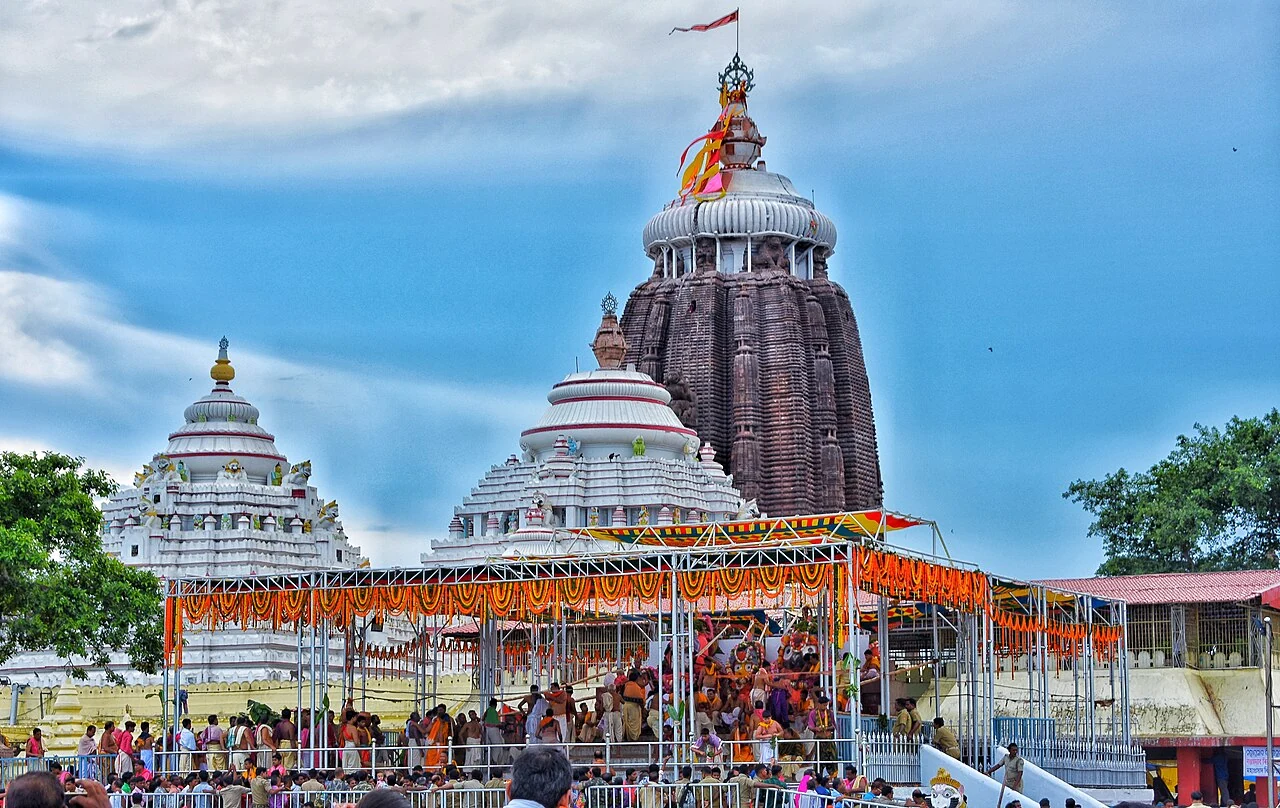
Puri’s monumental temple is central to Odisha’s religious and artistic life. Its deities are honoured through a distinctive ritual cycle, including the Rath Yatra. Temple tradition recounts the making of their wooden forms; these stories should be read as sacred narratives. Claims that the temple has no shadow or that its flag always defies the wind are not established scientific facts.
Mythological story & sacred tradition
Temple tradition
The hidden deity and the sacred wood
In the Jagannath origin cycle, King Indradyumna seeks Nila Madhava, worshipped by the forest-dweller Vishvavasu. Vidyapati discovers this worship, but the deity becomes hidden. The king’s search leads to a new manifestation in sacred wood. Jagannath’s distinctive form belongs to this story of divine presence exceeding an ordinary human likeness.
Versions differ about the divine carpenter, the closed workshop and the completion of the images. The Purushottama Mahatmya within the Skanda Purana is a major textual home of the Indradyumna cycle; later temple retellings should be read alongside it.
Story sources: 3
What makes it special
Jagannath, Balabhadra and Subhadra are worshipped in wooden forms, with an elaborate cycle of renewal, bathing and chariot journeys.
A temple and its annual cycle
Jagannath, Balabhadra and Subhadra stand at the centre of a ritual year that includes bathing ceremonies, periods of seclusion and the celebrated chariot journeys. The relationships among these events explain more than Ratha Yatra viewed in isolation. Temple rules for entry and participation should be checked directly with the administration.
A journey across four regions
The national Char Dham links Badrinath, Dwarka, Puri and Rameswaram. It brings together different languages, regional temple practices and landscapes. This is distinct from Uttarakhand’s four-shrine Himalayan circuit, which is also widely called Char Dham.
Visiting and learning more
Begin with the linked authority for the shrine’s history, worship and visitor services. Check entry conditions, dress, photography and any reservation requirements before your visit. Opening times and special arrangements can change during major festivals.
Getting there
Puri
- Local / nearest railhead
- Puri railway station
- Major long-distance railway option
- Puri railway station · Khurda Road Junction
- Nearest airport
- Biju Patnaik International Airport, Bhubaneswar (BBI)
Puri itself handles long-distance trains; Khurda Road is an additional main-line connection, not a compulsory transfer.
Travel source: Puri district · transport and visiting season · Odisha Tourism · Jagannath and Rath Yatra
Shree Jagannatha Temple Administration
Best time to visit
October–April (autumn to spring) is the district’s recommended visiting window; winter offers more comfortable coastal weather.
Festivals & occasions: Rath Yatra falls in Ashadha, usually June–July; confirm the temple’s annual calendar and expect monsoon weather and large crowds.
Season & festival references: Puri district · transport and visiting season · Odisha Tourism · Jagannath and Rath Yatra
Reviewed 21 November 2026. Seasonal windows are guidance; confirm weather, access and the current event programme before booking.
Arrival points apply to the named approach. A gateway is a practical travel option, not a claim that it is the closest stop. Confirm passenger services and the onward transfer before booking.
References & further reading
- Official temple administration website · shreejagannatha.in
Temple administration, government or heritage information for the shrine and current visitor arrangements. - Puri District · Shree Jagannath Temple
Government district information about the temple and reaching Puri; use it as a backup when the administration portal is unavailable. - Jagannath temple tradition · Legendary origin
Documents the tradition and its cultural setting; it does not establish the story as a historical event.