Official website and visitor information
Origin and course
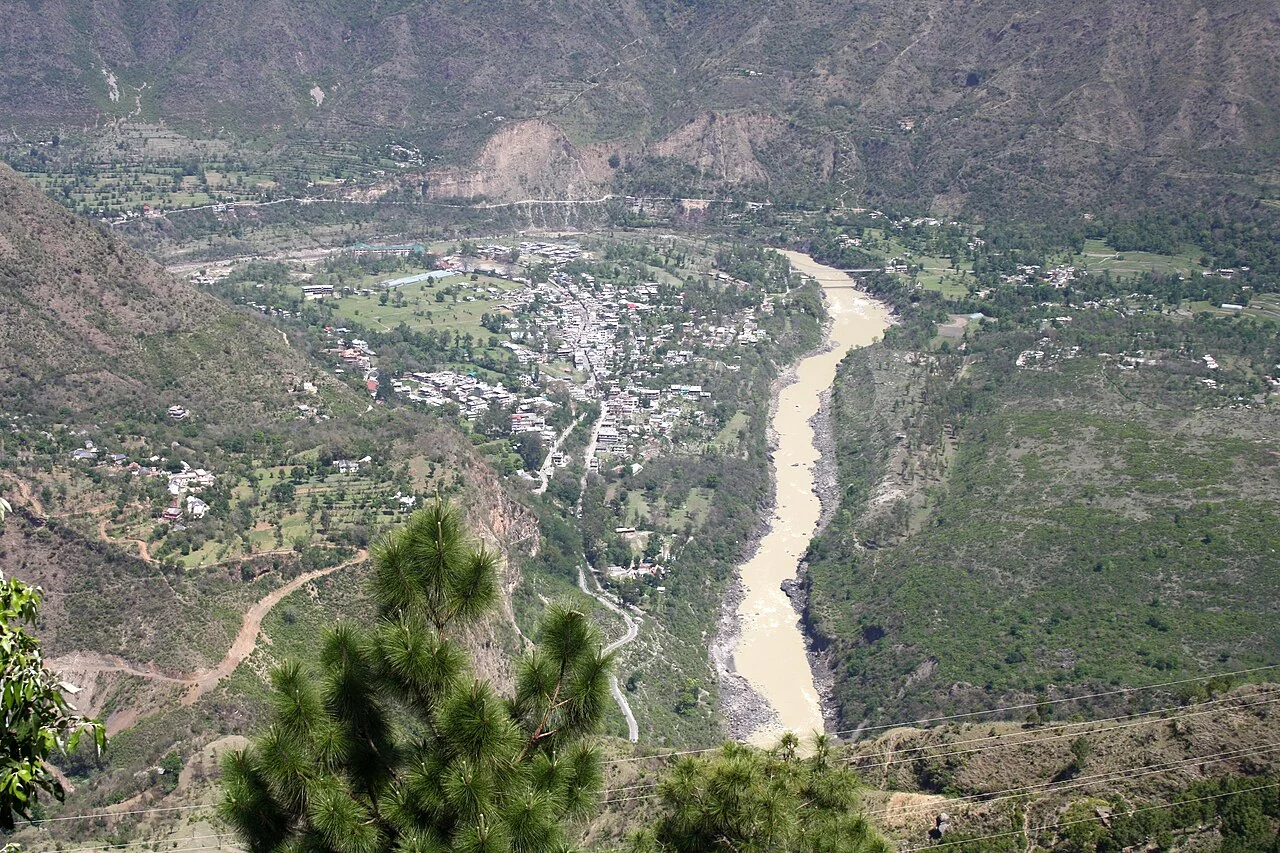
The Sutlej rises in the Tibetan region near Rakshastal, enters India near Shipki La, crosses Himachal Pradesh and Punjab, and joins the wider Indus system after meeting the Beas.
Mythology and sacred memory
A Vashishtha legend, recorded by Kullu district, gives the river the name Shatadru, “hundred channels”. Grieving after the loss of his sons, the sage enters the river, but its waters separate into shallow channels and preserve his life.
The story personifies the river as protective. It is a traditional explanation of a name, rather than a hydrological account proving that a particular ancient channel pattern has survived unchanged. Sutudri also appears among the rivers invoked in Rigveda 10.75.
Sangams and the journey downstream
In the high Himalaya, the Spiti joins the Sutlej at Khab in Kinnaur. Much farther downstream, the Beas meets it at Harike in Punjab. Following these two meetings reveals the river’s transformation from a mountain channel to part of a broad plains system.
Harike is also an important wetland for resident and migratory birds. Its ecological significance deserves attention alongside the older Shatadru traditions; not every important confluence needs an invented mythological origin story.
Festivals and living traditions
Makar Sankranti at Tattapani brings devotees to the hot-spring setting on the Sutlej’s banks. Himachal Pradesh Tourism records the tradition of communal bathing and prayer on this occasion.
The observance follows a solar transition in the traditional calendar, unlike festivals set by a full moon. It belongs to a particular riverside place, rather than being a single festival observed identically across the whole Sutlej basin.
What makes this river special
The Sutlej carries the reader from the high trans-Himalayan world towards Punjab’s plains. Its older names open a route into Vedic poetry and regional storytelling. Reading across those layers shows how one river can be remembered differently in a hymn, a local legend and a modern geographical account.
Explore with care
Read the linked geographical and cultural sources together: a sacred origin story explains religious meaning, while a drainage account explains the physical river. River levels, bathing arrangements and access can change.
View this river setting on Google Maps
Explore all river guides · Understand festival dates
Find the river meetings: Spiti–Sutlej at Khab · Beas–Sutlej at Harike.
Festival descriptions explain customary observances. Confirm the current programme and permitted access with the official sources below before travelling.
Getting there
Bhakra–Nangal area
- Local / regional railway option
- Nangal Dam railway station
- Major long-distance railway option
- Chandigarh railway station
- Practical airport gateway
- Shaheed Bhagat Singh International Airport, Chandigarh (IXC)
Confirm the train stop and onward road transfer before booking; railway options are practical approaches, not a surveyed ranking of every nearby station.
Travel source: Bhakra Beas Management Board · Bhakra project · BBMB · Nangal railhead · BBMB · visitor permits
Bhakra Beas Management Board · Bhakra project
The dam is regulated infrastructure. BBMB describes sightseeing permits issued by its Public Relations Office; confirm current permission, identity-document and nationality requirements before travel. Do not assume unrestricted access.
Bhakra Beas Management Board · Bhakra project · BBMB · Nangal railhead · BBMB · visitor permits
Best time to visit
Choose a mild spring or autumn day for outdoor sightseeing. Summer can be hot and monsoon conditions may restrict access.
Festivals & occasions: No fixed annual festival at the operational dam is asserted; consult the local programme for neighbouring towns.
Season & festival references: Bhakra Beas Management Board · Bhakra project · BBMB · Nangal railhead · BBMB · visitor permits
Reviewed 21 November 2026. Seasonal windows are guidance; confirm weather, access and the current event programme before booking.
Khab — Spiti–Sutlej confluence via Kinnaur
- Local / regional railway option
- Shimla railway station (narrow gauge)
- Major long-distance railway option
- Chandigarh railway station
- Practical airport gateway
- Shimla Airport, Jubbarhatti (SLV)
Other rail option: Kalka railway station · Other airport option: Shaheed Bhagat Singh International Airport, Chandigarh (IXC)
Shimla is the narrow-gauge regional railhead; Chandigarh is the broad-gauge gateway. Both need a long road transfer. Shimla Airport has limited services: compare Chandigarh flights before booking.
Travel source: Himachal Tourism · Kinnaur access and season · HPTDC · rail and road gateways
Himachal Tourism · Kinnaur access and season
Check district road advisories and any applicable protected-area requirements for your wider Kinnaur itinerary. This is confluence access, not source access.
Himachal Tourism · Kinnaur access and season · HPTDC · rail and road gateways
Best time to visit
Himachal Tourism recommends April–October for Kinnaur. Avoid road travel during heavy rain or landslide alerts; winter temperatures and snow can interrupt the route.
Festivals & occasions: No annual event at Khab confluence itself is confirmed. Kinnaur’s village festivals have their own local calendars.
Season & festival references: Himachal Tourism · Kinnaur access and season · HPTDC · rail and road gateways
Reviewed 21 November 2026. Seasonal windows are guidance; confirm weather, access and the current event programme before booking.
Tattapani, Himachal Pradesh
- Local / regional railway option
- Shimla railway station (narrow gauge)
- Major long-distance railway option
- Kalka railway station
- Practical airport gateway
- Shimla Airport, Jubbarhatti (SLV)
Other rail option: Chandigarh railway station · Other airport option: Shaheed Bhagat Singh International Airport, Chandigarh (IXC)
Use Shimla for the narrow-gauge approach or Kalka for broad-gauge connections, then continue by road. Compare limited Shimla flights with Chandigarh services.
Travel source: Himachal Tourism · Shimla and nearby routes · Himachal Tourism · regional fairs and observances
Himachal Tourism · Shimla and nearby routes
Follow designated bathing and river-access arrangements; do not enter fast-flowing water.
Himachal Tourism · Shimla and nearby routes · Himachal Tourism · regional fairs and observances
Best time to visit
Spring and autumn are practical sightseeing seasons. Winter is associated with the hot-spring pilgrimage; monsoon river conditions require caution.
Festivals & occasions: Makar Sankranti in January brings pilgrims to Tattapani; confirm local arrangements for the announced observance.
Season & festival references: Himachal Tourism · Shimla and nearby routes · Himachal Tourism · regional fairs and observances
Reviewed 21 November 2026. Seasonal windows are guidance; confirm weather, access and the current event programme before booking.
Rampur Bushahr riverfront
- Local / regional railway option
- Shimla railway station (narrow gauge)
- Major long-distance railway option
- Kalka railway station
- Practical airport gateway
- Shimla Airport, Jubbarhatti (SLV)
The rail stations serve the Shimla approach, followed by a substantial road journey to Rampur. Shimla Airport schedules are limited; Chandigarh is an alternative flight gateway.
Travel source: Himachal Tourism · Rampur and visiting season · Himachal Tourism · Shimla and nearby routes · Himachal Tourism · regional fairs and observances
Himachal Tourism · Rampur and visiting season
Best time to visit
Rampur is described by Himachal Tourism as a year-round destination. Spring and autumn are practical choices; check road conditions during heavy rain and winter weather.
Festivals & occasions: Lavi Fair is associated with Rampur in November; use the district’s annual programme for exact dates.
Season & festival references: Himachal Tourism · Rampur and visiting season · Himachal Tourism · Shimla and nearby routes · Himachal Tourism · regional fairs and observances
Reviewed 21 November 2026. Seasonal windows are guidance; confirm weather, access and the current event programme before booking.
Harike — Beas–Sutlej confluence
- District-listed local approach (nearest not established)
- Firozpur Cantt railway station
- Major long-distance railway option
- Firozpur Cantt railway station
- Amritsar airport gateway
- Sri Guru Ram Dass Jee International Airport, Amritsar (ATQ)
Firozpur Cantt is the district-listed rail gateway and also a major station. The exact closest passenger stop to your selected wetland entrance has not been established. Use the authorised entry point and arrange the road transfer. The same station serves both local arrival and longer-distance journeys; a second minor station is not needed.
Travel source: Ferozepur district · Harike access
Bhakra Beas Management Board · Bhakra project
Best time to visit
Winter, especially November–February, is the birdwatching season. Confirm permitted entry, water levels and any local restrictions before visiting.
Festivals & occasions: A Harike Wetland Festival is described by the Ministry of Tourism as a winter event; check the current announced edition.
Season & festival references: Ministry of Tourism · Harike winter wildlife season
Reviewed 21 November 2026. Seasonal windows are guidance; confirm weather, access and the current event programme before booking.
Arrival points apply to the named approach. A gateway is a practical travel option, not a claim that it is the closest stop. Confirm passenger services and the onward transfer before booking.
Sources & further reading
Read the evidence and traditions behind this guide.
- NCERT · India: Physical Environment, Drainage System
- Kullu district · Vashishtha, Vipasha and Shatadru traditions
- Rigveda 10.75 · Hymn to the rivers, Griffith translation
- Lahaul and Spiti district · Spiti’s meeting with Sutlej at Khab
- Ferozepur district · Harike wetland at the Beas–Sutlej confluence
- Himachal Pradesh Tourism · Tattapani and Makar Sankranti