Official website and visitor information
Origin and course
The Krishna rises near Mahabaleshwar in Maharashtra and flows east through the Deccan to the Bay of Bengal. The Bhima and Tungabhadra are major tributaries. Its basin joins mountain rainfall, interior farming regions and the coastal delta.
Mythology and sacred memory
Mahabaleshwar’s Panchganga temple brings five rivers together in sacred geography: Krishna, Koyna, Venna, Savitri and Gayatri. The India-WRIS basin report records a local legend in which the Krishna represents Vishnu following Savitri’s curse upon the Trimurti.
The tradition gives the spring landscape a divine identity. The Krishna river’s name should not automatically turn every source legend into a story about Krishna’s childhood in Braj; those well-known episodes are especially associated with the Yamuna.
Sangams and the journey downstream
At Kudalasangama in Karnataka, the Malaprabha joins the Krishna. The confluence is strongly associated with Basavanna, the twelfth-century reformer and devotional poet, and the tradition of his aikya, or union with God. This is a distinct layer of sacred memory from the source legend at Mahabaleshwar.
Other major tributaries, including the Bhima and Tungabhadra, enlarge the river on its eastward journey. A tributary’s own pilgrimage places belong to the Krishna basin without necessarily standing on the main Krishna channel.
Festivals and living traditions
Krishna Pushkaralu is a river-worship festival normally recurring at roughly twelve-year intervals. Its traditional timing follows Jupiter’s entry into Kanya, or Virgo, with the principal observance spanning twelve days. Bathing, ancestor rites, religious teaching and devotional programmes connect the river with family and community memory.
This calendar is an astrological religious convention; it does not establish that water quality changes with a planet’s zodiacal position. Follow current Andhra Pradesh and Telangana announcements for designated ghats and access.
What makes this river special
The river illustrates how a modest mountain headwater can become a major peninsular system through its tributaries. Pilgrimage and daily water use exist alongside each other. Reading the basin as a whole helps connect the shrine at its source with people far downstream who depend on the same seasonal water.
Explore with care
Read the linked geographical and cultural sources together: a sacred origin story explains religious meaning, while a drainage account explains the physical river. River levels, bathing arrangements and access can change.
View this river setting on Google Maps
Explore all river guides · Understand festival dates
Find the river meetings: Krishna–Malaprabha Sangam.
Festival descriptions explain customary observances. Confirm the current programme and permitted access with the official sources below before travelling.
Getting there
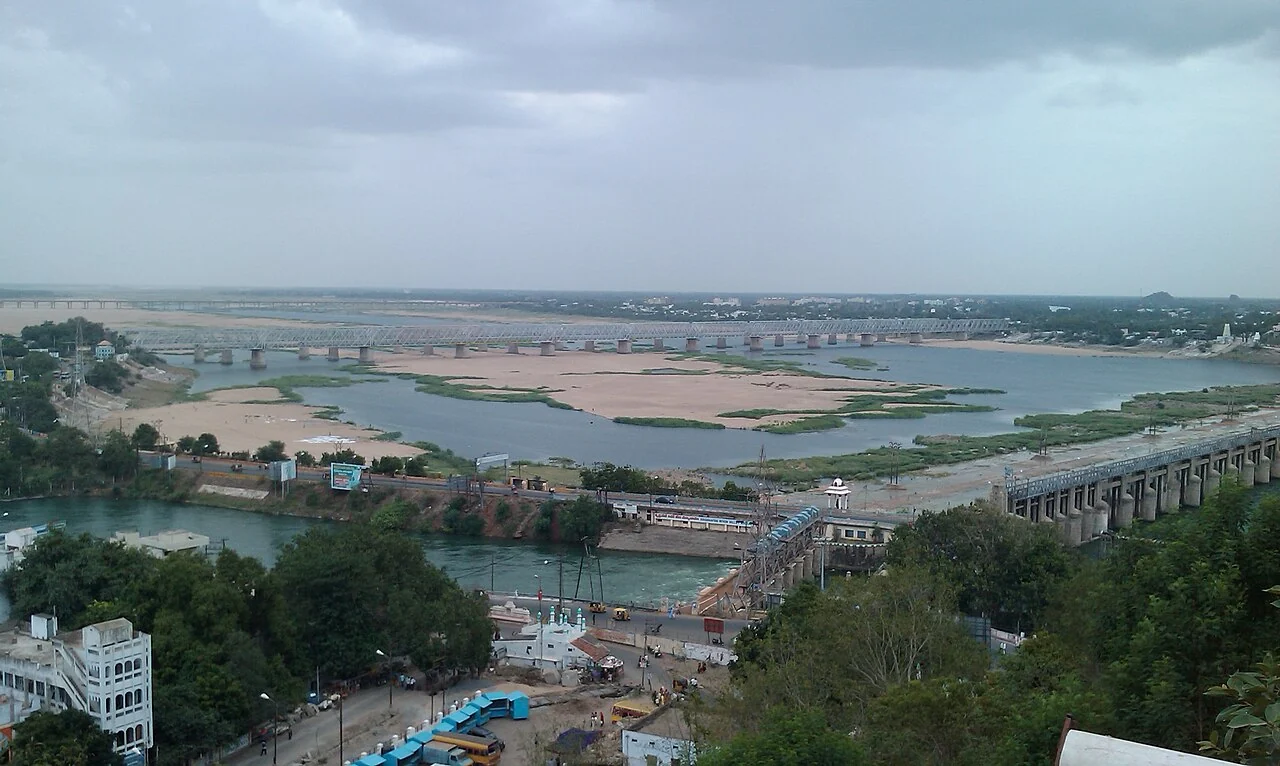
Vijayawada riverfront
- Local / regional railway option
- Vijayawada Junction
- Major long-distance railway option
- Vijayawada Junction
- Practical airport gateway
- Vijayawada International Airport (VGA)
Confirm the train stop and onward road transfer before booking; railway options are practical approaches, not a surveyed ranking of every nearby station. The same station serves both local arrival and longer-distance journeys; a second minor station is not needed.
Travel source: Ministry of Tourism · Krishna river access via Vijayawada · Ministry of Tourism · regional climate and gateways
Ministry of Tourism · Krishna river access via Vijayawada
Boat access to islands is separate from reaching the city; use authorised services and check current operations.
Ministry of Tourism · Krishna river access via Vijayawada · Ministry of Tourism · regional climate and gateways
Best time to visit
The cooler winter season is more comfortable for riverfront sightseeing; avoid exposed midday visits in summer and heed flood warnings in the monsoon.
Festivals & occasions: Krishna Pushkaram is a periodic river festival, not an annual event. Check the state’s announced dates and designated ghats before planning a festival visit.
Season & festival references: Ministry of Tourism · Krishna river access via Vijayawada · Ministry of Tourism · regional climate and gateways
Reviewed 21 November 2026. Seasonal windows are guidance; confirm weather, access and the current event programme before booking.
Kudalasangama — Krishna–Malaprabha confluence
- Local / nearest railway option
- Almatti railway station
- Major long-distance railway option
- Bagalkot railway station
- Nearest major airport in the official guide
- Hubballi Airport (HBX)
Official guidance offers Almatti and Bagalkot as railway approaches; compare train stops and the road transfer rather than assuming one universal closest option.
Travel source: Official destination guide · Karnataka Tourism · seasons
Follow instructions at the temple, samadhi and confluence. High river levels can make ritual bathing unsafe.
Official destination guide · Karnataka Tourism · seasons
Best time to visit
October–February is Karnataka Tourism’s general cooler-season recommendation for sightseeing.
Festivals & occasions: The annual Jatra and Basava Jayanti bring major gatherings; check the current programme.
Season & festival references: Official destination guide · Karnataka Tourism · seasons
Reviewed 21 November 2026. Seasonal windows are guidance; confirm weather, access and the current event programme before booking.
Arrival points apply to the named approach. A gateway is a practical travel option, not a claim that it is the closest stop. Confirm passenger services and the onward transfer before booking.
Sources & further reading
Read the evidence and traditions behind this guide.