Official website and visitor information
Origin and course
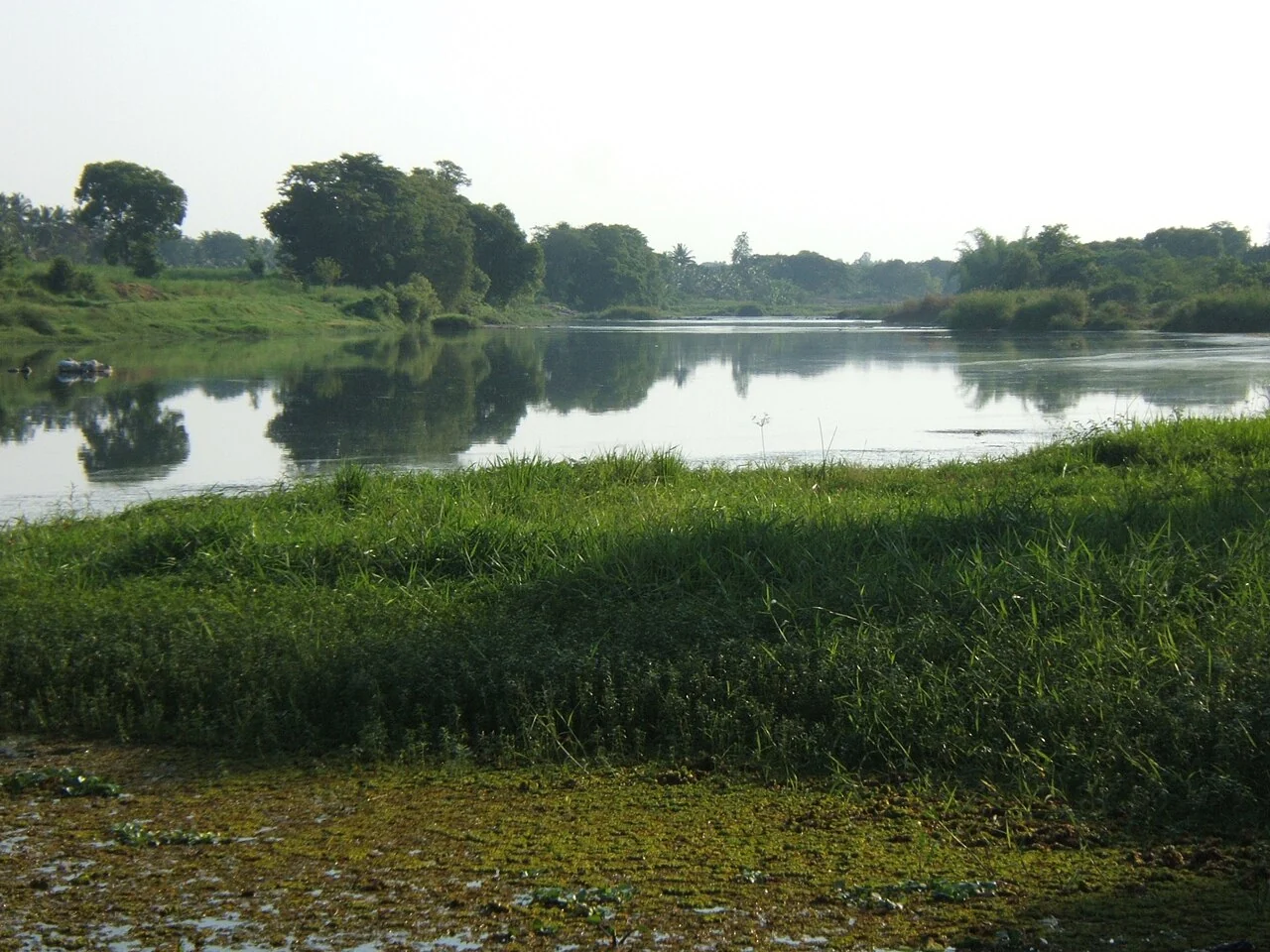
Talakaveri in the Brahmagiri hills of Kodagu, Karnataka, is honoured as the source of the Kaveri. The river crosses Karnataka and Tamil Nadu before reaching the Bay of Bengal through its delta. Talakaveri’s sacred spring and the wider drainage network should be understood together.
Mythology and sacred memory
The Coorg District Gazetteer records the tradition of Agastya’s water vessel, or kamandalu. Ganesha takes the form of a crow and overturns it, allowing Kaveri to flow. The story gives divine purpose to the river’s release into the landscape.
Talakaveri’s annual Tula Sankramana observance honours the source. Devotees understand the spring’s rising water through the goddess’s presence; this religious interpretation sits alongside the geography of springs, rainfall and river flow.
Sangams and the journey downstream
Close to the source, Bhagamandala is revered as the meeting of Kaveri, Kannike and Sujyoti. The Sujyoti is described in local sacred geography as subterranean; readers should distinguish this traditional third river from the visible waterways.
Farther downstream in Tamil Nadu, Bhavani Kooduthurai is the meeting of the Kaveri and Bhavani. Tradition adds the unseen Amudha to make another sacred triple confluence. These two sangams have their own names and regional traditions; neither is the Prayagraj Sangam of the Ganga and Yamuna.
Festivals and living traditions
Tula Sankramana, usually in October, honours Kaveri at Talakaveri. Devotees understand the source spring’s appearance or rising water through the presence of the goddess, linking the festival to the story of the river’s release into the world.
In Tamil Nadu, Aadi Perukku celebrates the river’s life-giving role and the seasonal abundance of water. Erode district identifies it as a major observance at Bhavani Kooduthurai. Together these celebrations connect the hill source with the farming landscapes downstream.
What makes this river special
The Kaveri’s significance reaches from Kodagu’s hills to the southern agricultural plains. Its water, river islands and temple towns belong to a shared regional heritage. The nurturing image of the river also invites responsibility: communities upstream and downstream are connected through their use of water.
Explore with care
Read the linked geographical and cultural sources together: a sacred origin story explains religious meaning, while a drainage account explains the physical river. River levels, bathing arrangements and access can change.
View this river setting on Google Maps
Explore all river guides · Understand festival dates
Find the river meetings: Bhagamandala Sangam · Bhavani Kooduthurai.
Festival descriptions explain customary observances. Confirm the current programme and permitted access with the official sources below before travelling.
Getting there
Srirangam
- Local / regional railway option
- Srirangam railway station
- Major long-distance railway option
- Tiruchirappalli Junction
- Practical airport gateway
- Tiruchirappalli International Airport (TRZ)
Confirm the train stop and onward road transfer before booking; railway options are practical approaches, not a surveyed ranking of every nearby station.
Travel source: Tiruchirappalli district · Srirangam · Southern Railway · station list · Ministry of Tourism · Tiruchirappalli
Tiruchirappalli district · Srirangam
Choose the exact ghat before travelling: this arrival guide is for Srirangam island, not the Kaveri source.
Tiruchirappalli district · Srirangam · Southern Railway · station list · Ministry of Tourism · Tiruchirappalli
Best time to visit
Winter is the more comfortable sightseeing season; summer afternoons are hot, while the northeast monsoon can affect riverside access.
Festivals & occasions: The Srirangam temple has a major festival calendar, including its Float Festival; use the temple’s current announcement for dates.
Season & festival references: Tiruchirappalli district · Srirangam · Southern Railway · station list · Ministry of Tourism · Tiruchirappalli
Reviewed 21 November 2026. Seasonal windows are guidance; confirm weather, access and the current event programme before booking.
Bhavani Kooduthurai — river confluence
- Local / regional railway option
- Erode Junction
- Major long-distance railway option
- Erode Junction
- Practical airport gateway
- Coimbatore International Airport (CJB)
Confirm the train stop and onward road transfer before booking; railway options are practical approaches, not a surveyed ranking of every nearby station. The same station serves both local arrival and longer-distance journeys; a second minor station is not needed.
Travel source: Erode district · Bhavani Sangameswarar and festivals · Erode district · rail and airport access
Erode district · Bhavani Sangameswarar and festivals
The district describes the third, underground Amudha river as part of sacred tradition. Follow local river-access restrictions rather than assuming ritual bathing is safe.
Erode district · Bhavani Sangameswarar and festivals · Erode district · rail and airport access
Best time to visit
Prefer the cooler winter months for walks around the confluence. Summer is hot; monsoon river levels can restrict access to the water.
Festivals & occasions: Aadi Perukku is an important confluence festival; the temple also observes Maha Shivaratri, Navaratri and its car festival. Confirm the annual dates.
Season & festival references: Erode district · Bhavani Sangameswarar and festivals · Erode district · rail and airport access
Reviewed 21 November 2026. Seasonal windows are guidance; confirm weather, access and the current event programme before booking.
Bhagamandala Sangam via Madikeri
- Local / regional railway option
- Mysuru Junction
- Major long-distance railway option
- Mysuru Junction
- Practical airport gateway
- Kannur International Airport (CNN)
Other airport option: Mysuru Airport (MYQ)
Kodagu has no railway. Mysuru is a documented regional rail gateway; Kannur is a practical airport approach. The nearest choice varies with the road route, and the district lists several alternatives. The same station serves both local arrival and longer-distance journeys; a second minor station is not needed.
Travel source: Kodagu district · Bhagamandala and regional access · Karnataka Tourism · seasons
Kodagu district · Bhagamandala and regional access
This guide is for Bhagamandala Sangam only; it does not add transport instructions for the river’s headwaters.
Kodagu district · Bhagamandala and regional access · Karnataka Tourism · seasons
Best time to visit
October–March is a useful regional planning window for Kodagu. The wet monsoon can bring slippery approaches and swollen rivers.
Festivals & occasions: Confirm local temple observances with Bhagandeshwara Temple; dates and crowd arrangements are separate from ordinary sightseeing.
Season & festival references: Kodagu district · Bhagamandala and regional access · Karnataka Tourism · seasons
Reviewed 21 November 2026. Seasonal windows are guidance; confirm weather, access and the current event programme before booking.
Arrival points apply to the named approach. A gateway is a practical travel option, not a claim that it is the closest stop. Confirm passenger services and the onward transfer before booking.
Sources & further reading
Read the evidence and traditions behind this guide.
- Kodagu district · Talacauvery
- Karnataka State Archives · Coorg District Gazetteer, chapter 1
- NCERT · Drainage, Contemporary India I
- Kodagu district · Bhagamandala
- Karnataka Tourism · Talakaveri, Sujyoti tradition and Tula Sankramana
- Erode district · Bhavani Kooduthurai and Aadi Perukku
- Press Trust of India via The Week · Aadi Perukku and the mythical Amudha, 3 August 2025