Official website and visitor information
Origin and course
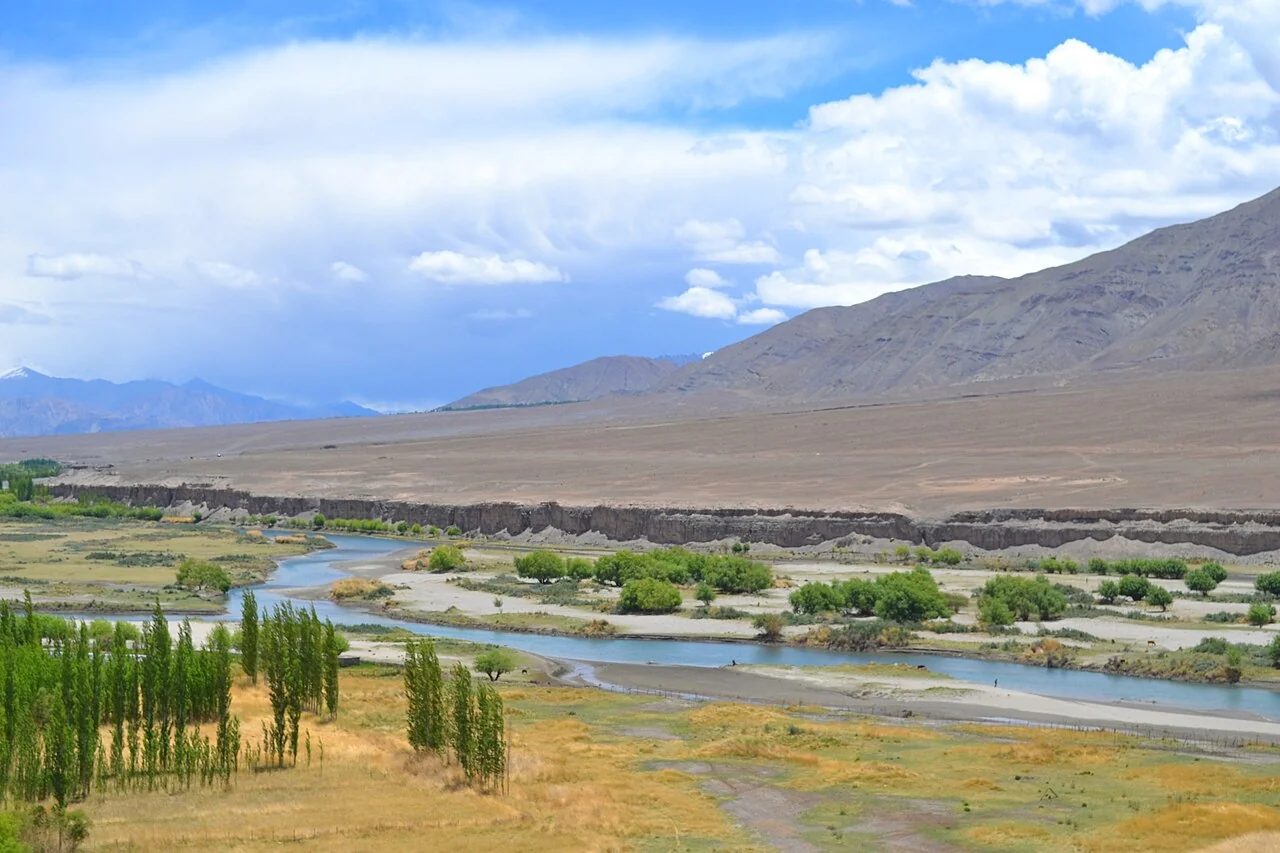
The Indus rises in the Tibetan Kailash region, passes through Ladakh and continues through Pakistan to the Arabian Sea. Its basin extends well beyond modern India’s boundaries.
Mythology and sacred memory
The Rigveda’s river hymn, 10.75, celebrates Sindhu’s strength, its rushing waters and the tributaries that gather around it. Varuna is described as opening its channels. The river is imagined through horses, chariots and royal power: poetry makes a physical force into a sacred presence.
This is an early textual celebration of a river, rather than a single later birth legend. Reading the hymn alongside a modern map shows how geography can become part of cultural memory without treating every poetic image as literal history.
Sangams and the journey downstream
At Nimmu, near Leh, the Zanskar joins the Indus in a dramatic mountain confluence often called Sangam. Differences in sediment can make their waters look distinct before mixing; colours vary with season and conditions. This physical meeting gives a particularly clear view of how tributaries build a larger river.
The Rigvedic praise of Sindhu concerns the river and its wider tributary world. It should not be turned into an unsupported claim that this particular viewpoint has a named origin legend in the hymn.
Festivals and living traditions
Sindhu Darshan celebrates the river at Sindhu Ghat near Shey in Ladakh, with prayers and cultural programmes emphasising shared heritage. It is a modern organised festival: the Ministry of Tourism records its first celebration in 1997. Its antiquity lies in the reverence for Sindhu, not in an unbroken ancient history for this particular event.
Use Ladakh administration or organiser announcements for each year’s programme; dates on older tourism listings should not be reused as a current schedule.
What makes this river special
The name Sindhu is connected with the historical chain of names leading to Hindu and India. The Indus world also evokes the Bronze Age Harappan civilisation, whose sites extend across today’s India and Pakistan. In Ladakh, the river’s high-altitude setting offers a very different view from the lower plains: one river belongs to many landscapes and histories.
Explore with care
Read the linked geographical and cultural sources together: a sacred origin story explains religious meaning, while a drainage account explains the physical river. River levels, bathing arrangements and access can change.
View this river setting on Google Maps
Explore all river guides · Understand festival dates
Find the river meetings: Indus–Zanskar Sangam · Sindhu Ghat.
Festival descriptions explain customary observances. Confirm the current programme and permitted access with the official sources below before travelling.
Getting there
Shey and Sindhu Ghat via Leh
- Local railway station — none in Ladakh
- No direct rail arrival at this destination
- Major long-distance railway option
- Jammu Tawi railway station
- Nearest airport
- Kushok Bakula Rimpochee Airport, Leh (IXL)
Additional railway gateway: Shri Mata Vaishno Devi Katra railway station
Jammu Tawi and Shri Mata Vaishno Devi Katra (SVDK) both require a substantial onward journey to Ladakh. Neither is ranked as nearest here: passenger trains also reach Srinagar. Compare the complete rail-and-road journey, road opening and acclimatisation stops before booking.
Travel source: Ministry of Railways · Jammu–Katra–Srinagar passenger link, April 2026 · Leh district · air and road access · Incredible India · Hemis airport
Leh district · official visitor guide
Best time to visit
Summer, May–September, is the regional sightseeing window. Winter is extremely cold; check roads and local access before a visit outside the main season.
Festivals & occasions: Sindhu Darshan is associated directly with Sindhu Ghat, generally in June. Different organisers can have different festival and Yatra dates, so use the relevant programme. Shey Rul-lo is separately listed at Shey in March; it is not the same event as Sindhu Darshan.
Season & festival references: Ladakh Tourism · seasonal guidance · Ladakh Administration · Sindhu Darshan venue · Leh district · Shey festival listing
Reviewed 14 November 2026. Seasonal windows are guidance; confirm weather, access and the current event programme before booking.
Entry permits & fees
Ladakh visitor permissions
Indian visitors: check the district portal for environmental, Red Cross and wildlife charges applicable to your itinerary. Foreign visitors: protected/restricted-area permissions depend on the route, nationality and passport/visa category. A monastery or riverbank visit is not automatically subject to the same conditions as a border circuit.
Confirm your exact route with the district authority or registered operator. Ask for government charges separately from guide, accommodation and transport costs, and retain receipts. The official portal below provides the applicable process; no unsupported flat Indian/foreign fee is quoted here.
Official permit & fee sources: Leh district permit and fee portal · Official foreign-visitor permit guidance
Reviewed 14 November 2026. Recheck the official notice for your nationality, route and travel dates before payment.
Nimmu — Indus–Zanskar Sangam via Leh
- Local railway station — none in Ladakh
- No direct rail arrival at this destination
- Major long-distance railway option
- Jammu Tawi railway station
- Nearest airport
- Kushok Bakula Rimpochee Airport, Leh (IXL)
Additional railway gateway: Shri Mata Vaishno Devi Katra railway station
Jammu Tawi and Shri Mata Vaishno Devi Katra (SVDK) both require a substantial onward journey to Ladakh. Neither is ranked as nearest here: passenger trains also reach Srinagar. Compare the complete rail-and-road journey, road opening and acclimatisation stops before booking.
Travel source: Ministry of Railways · Jammu–Katra–Srinagar passenger link, April 2026 · Leh district · air and road access · Incredible India · Hemis airport
Leh district · official visitor guide
Best time to visit
Summer, May–September, is the main regional sightseeing window. Ladakh Tourism also describes September–October as an autumn visiting season; choose dates according to road and weather conditions at the confluence.
Festivals & occasions: The district calendar lists a Ladakh River Festival at Sangam point in August. A current edition and date were not confirmed in this review, so treat this as an event to check rather than a guaranteed annual booking. Sindhu Darshan takes place at Sindhu Ghat, not at this confluence.
Season & festival references: Ladakh Tourism · summer and autumn · Leh district · Sangam-point event listing
Reviewed 14 November 2026. Seasonal windows are guidance; confirm weather, access and the current event programme before booking.
Entry permits & fees
Ladakh visitor permissions
Indian visitors: check the district portal for environmental, Red Cross and wildlife charges applicable to your itinerary. Foreign visitors: protected/restricted-area permissions depend on the route, nationality and passport/visa category. A monastery or riverbank visit is not automatically subject to the same conditions as a border circuit.
Confirm your exact route with the district authority or registered operator. Ask for government charges separately from guide, accommodation and transport costs, and retain receipts. The official portal below provides the applicable process; no unsupported flat Indian/foreign fee is quoted here.
Official permit & fee sources: Leh district permit and fee portal · Official foreign-visitor permit guidance
Reviewed 14 November 2026. Recheck the official notice for your nationality, route and travel dates before payment.
Arrival points apply to the named approach. A gateway is a practical travel option, not a claim that it is the closest stop. Confirm passenger services and the onward transfer before booking.
Sources & further reading
Read the evidence and traditions behind this guide.
- NCERT · India: Physical Environment, Drainage System
- Rigveda 10.75 · Hymn to the rivers, Griffith translation
- UNESCO · Archaeological Ruins at Moenjodaro
- Ladakh Tourism · Nimmu confluence
- Ministry of Tourism · Sindhu Darshan and its modern beginnings
- Ladakh administration · Sindhu Darshan celebration, June 2026