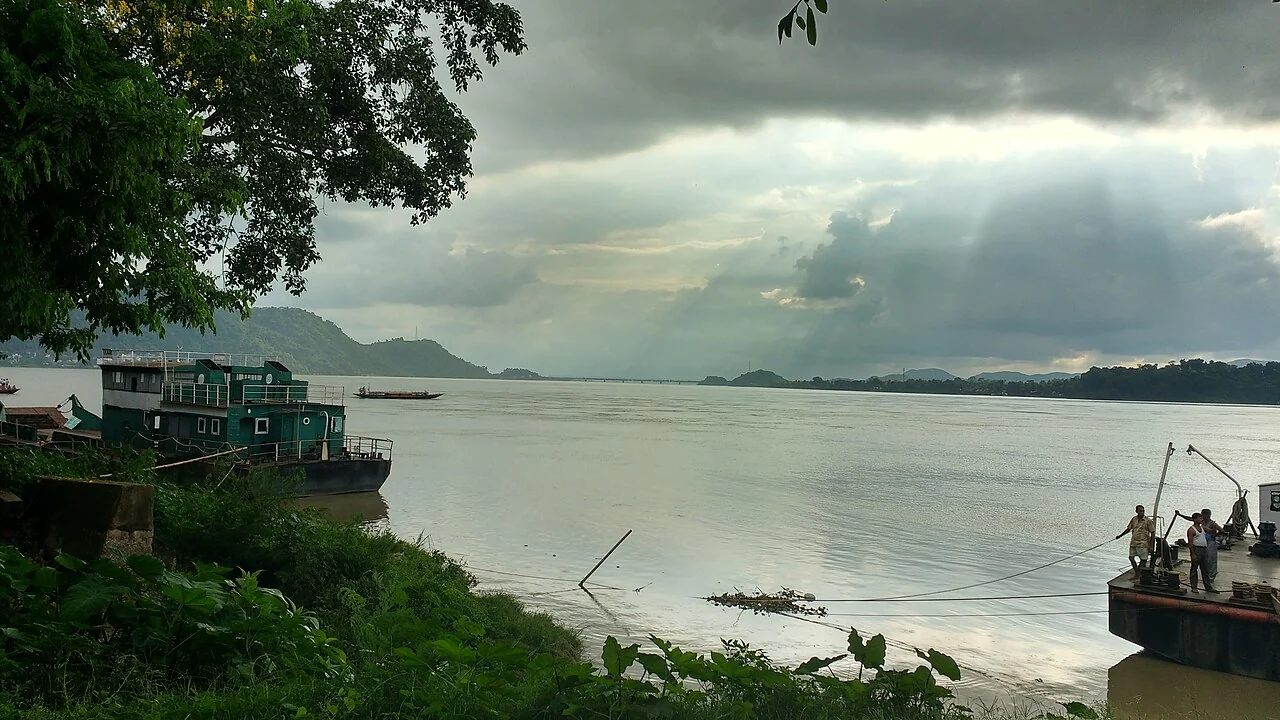
Origin and course
The river begins on the Tibetan Plateau, where it is known as the Yarlung Tsangpo. It bends around the eastern Himalaya, enters Arunachal Pradesh as the Siang/Dihang, crosses Assam as the Brahmaputra, and continues into Bangladesh as the Jamuna.
Mythology and sacred memory
The name Brahmaputra means “son of Brahma”. The Assam government’s The Mahabahu Brahmaputra recounts an origin tradition associated with the sage Shantanu and his wife Amogha. This personified river belongs to a sacred story-world, distinct from the physical source traced by geography.
Another important pilgrimage in this river system is Parashuram Kund, associated with repentance and purification. It is on the Lohit, a tributary, rather than on the main Brahmaputra channel. Keeping that distinction preserves both the story and the map.
Sangams and the journey downstream
Near the Sadiya region, the Siang, Dibang and Lohit come together to form the broad Brahmaputra of Assam. This is a great meeting of Himalayan drainage systems, not a single fixed bathing ghat. Its braided channels and sandbanks can shift, so a map of the region is more useful than imagining one permanent point for every season.
The name “son of Brahma” also reminds us that sacred river personification in India is not exclusively maternal.
Festivals and living traditions
Parashuram Kund Mela is held around Makar Sankranti on the Lohit tributary. Lohit district’s account relates the belief that Parashurama was freed here from the sin of killing his mother; another local telling describes the axe becoming detached from his hand after contact with the water. The pilgrimage centres on repentance and purification.
This is a festival within the Brahmaputra basin, not a claim that Parashuram Kund lies on the main Brahmaputra. The river also sustains many communities whose traditions are not captured by a single Hindu narrative.
What makes this river special
Wide channels and shifting river islands make this a landscape of continual change. The river links communities with different languages, livelihoods and religious practices; Assam’s river journeys should therefore be understood through local lives as well as scenery. Its seasonal power brings fertile sediment and also flood and erosion hazards.
Explore with care
Read the linked geographical and cultural sources together: a sacred origin story explains religious meaning, while a drainage account explains the physical river. River levels, bathing arrangements and access can change.
View this river setting on Google Maps
Explore all river guides · Understand festival dates
Find the river meetings: Siang–Dibang–Lohit region · Parashuram Kund, Lohit.
Festival descriptions explain customary observances. Confirm the current programme and permitted access with the official sources below before travelling.
Getting there
Guwahati riverfront
- City railway station and major hub
- Guwahati railway station
- Major long-distance railway option
- Guwahati railway station
Guwahati station is both a city railhead and a major long-distance hub. Select the riverfront ghat before arranging the final transfer. The same station serves both local arrival and longer-distance journeys; a second minor station is not needed.
Travel source: Ministry of Tourism · Guwahati transport and October–March season
Ministry of Tourism · Guwahati transport and October–March season
Best time to visit
October–March is the most comfortable general visiting period. Monsoon river levels can change boat operations and access to the banks.
Festivals & occasions: Bihu celebrations occur in January, April and October across Assam; verify the particular city venue.
Season & festival references: Ministry of Tourism · Guwahati transport and October–March season · Ministry of Tourism · Bihu seasons
Reviewed 21 November 2026. Seasonal windows are guidance; confirm weather, access and the current event programme before booking.
Majuli via Nimati Ghat
- Nearest mainland railhead for the Jorhat approach
- Jorhat Town railway station
- Major long-distance railway option
- Mariani Junction
- Jorhat airport for the Nimati Ghat approach
- Jorhat Airport (JRH)
These are mainland stations for the Nimati Ghat approach, not stations on Majuli. Continue by road and an authorised ferry. Compare Mariani services for long-distance journeys.
Travel source: Majuli district · Jorhat gateway and October–March season · Ministry of Tourism · Jorhat Town and Mariani rail access
Majuli district · Jorhat gateway and October–March season
Best time to visit
October–March offers cooler weather and the island’s principal cultural season. Ferry services and water levels must be checked even during the dry season.
Festivals & occasions: Majuli Raas Leela is normally in November; exact dates follow the lunar calendar and the satras’ programmes.
Season & festival references: Majuli district · Jorhat gateway and October–March season · Assam Tourism · Raas Leela
Reviewed 21 November 2026. Seasonal windows are guidance; confirm weather, access and the current event programme before booking.
Parashuram Kund on the Lohit
- Railhead listed by Arunachal Tourism
- Tinsukia railway station
- Major long-distance railway option
- New Tinsukia Junction
- Dibrugarh regional flight gateway (not a nearest-airport claim)
- Dibrugarh Airport (DIB)
Tinsukia is the official listed railhead; compare New Tinsukia Junction for mainline services and continue by road. Dibrugarh is the official listed regional air gateway; Tezu is closer geographically, but current suitable flights need separate confirmation. Arunachal entry permission is separate from transport.
Travel source: Arunachal Tourism · Parashuram Kund transport and November–February season · Lohit district · Parashuram Kund and Makar Sankranti mela
Arunachal Tourism · Parashuram Kund transport and November–February season
Best time to visit
November–February is the official tourism visiting window. Check the road, permit and riverbank access conditions before travelling.
Festivals & occasions: The Parashuram Kund Mela centres on Makar Sankranti in January. Confirm the current administration programme.
Season & festival references: Arunachal Tourism · Parashuram Kund transport and November–February season · Lohit district · mela
Reviewed 21 November 2026. Seasonal windows are guidance; confirm weather, access and the current event programme before booking.
Arrival points apply to the named approach. A gateway is a practical travel option, not a claim that it is the closest stop. Confirm passenger services and the onward transfer before booking.
Sources & further reading
Read the evidence and traditions behind this guide.
- NCERT · India: Physical Environment, Drainage System
- Government of Assam · The Mahabahu Brahmaputra
- Arunachal Pradesh · Lohit district handbook, Parashuram Kund
- Central Water Commission · Brahmaputra morphology report: the three-river meeting
- Lohit district · Parashuram Kund Mela
- Lohit district · Parashuram Kund tradition