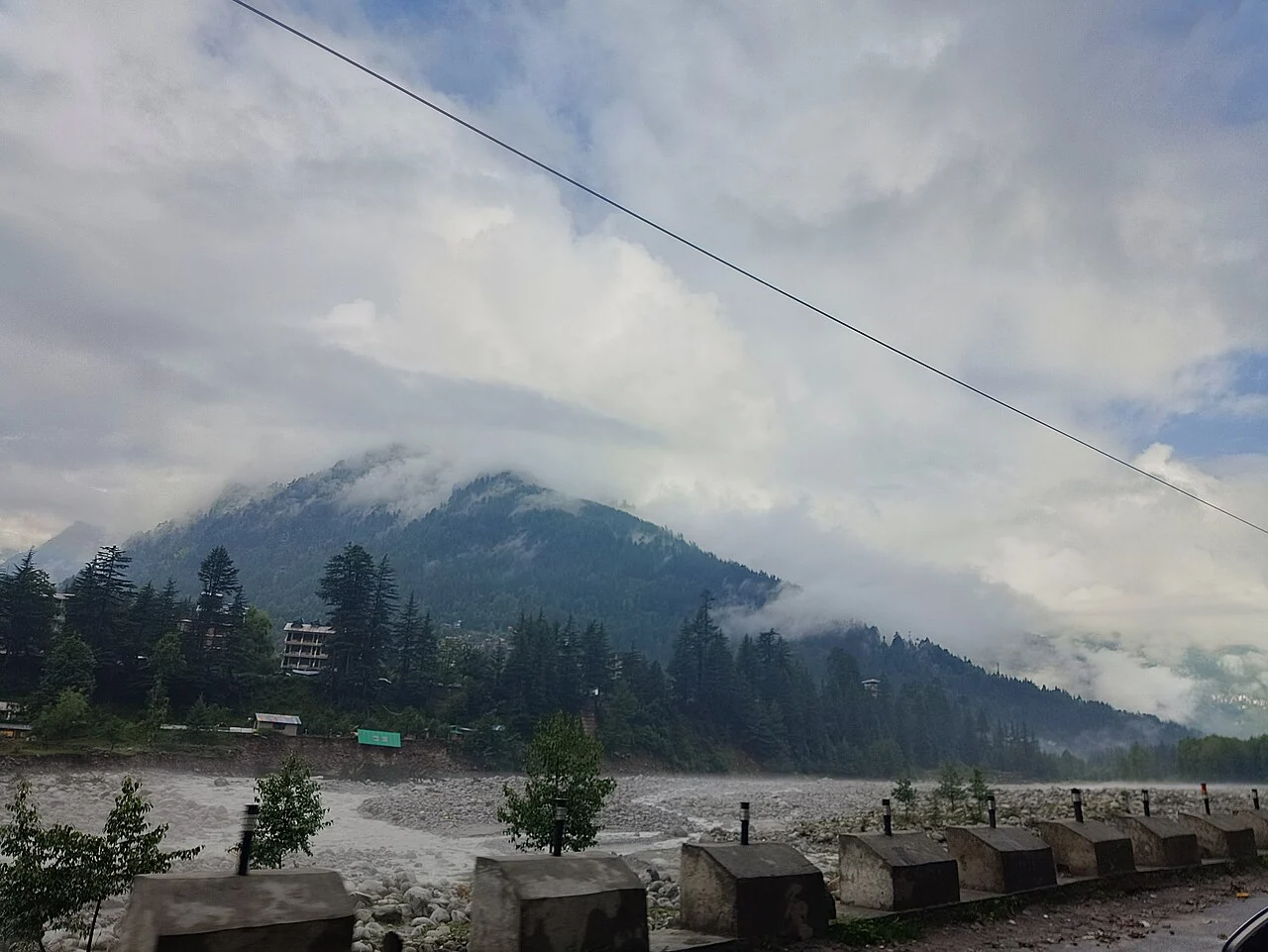
Origin and course
The Beas rises near Rohtang in Himachal Pradesh, flows through the Kullu valley and joins the Sutlej at Harike in Punjab.
Mythology and sacred memory
In the story recorded by Kullu district, Vashishtha enters the river bound by ropes after the loss of his sons. The river releases his bonds and carries him safely ashore; the name Vipasha is explained as freedom from bonds.
A separate local association connects the sage Vyasa’s meditation at Vyas Kund with the name Beas. These accounts are presented as traditions about sages and sacred places, not as certain linguistic derivations established by the stories alone.
Sangams and the journey downstream
At Bhuntar, the Parvati joins the Beas, connecting the two valleys. The Beas then continues towards Punjab, where it meets the Sutlej at Harike. These are different meetings at different stages of the journey.
The Vashishtha and Vyasa traditions explain the river’s sacred associations. The confluence at Harike also has a distinct modern importance as a wetland habitat; a river can hold devotional and ecological significance without requiring the same story at every place.
Festivals and living traditions
Kullu Dussehra is a major festival of the Beas valley. At Dhalpur, the gathering of local deities around Raghunath, the chariot procession and folk performance express the valley’s living religious culture.
This is a valley festival associated with Rama and the local deities, not a celebration of the Beas’s birth or a Kumbh at Harike. The distinction helps visitors understand what is actually being celebrated. Use the official Kullu Dussehra website for each year’s programme.
What makes this river special
The Beas gives continuity to the Kullu valley’s settlements, cultivation and sacred places. Its mountain setting makes the difference between a river’s scenic appeal and its physical force especially clear. The joining with the Sutlej at Harike also places it within a much larger drainage system, beyond the valley most visitors first encounter.
Explore with care
Read the linked geographical and cultural sources together: a sacred origin story explains religious meaning, while a drainage account explains the physical river. River levels, bathing arrangements and access can change.
View this river setting on Google Maps
Explore all river guides · Understand festival dates
Find the river meetings: Beas–Parvati at Bhuntar · Beas–Sutlej at Harike.
Festival descriptions explain customary observances. Confirm the current programme and permitted access with the official sources below before travelling.
Getting there
Manali stretch
- Nearest narrow-gauge railhead
- Joginder Nagar railway station
- Major long-distance railway option
- Chandigarh railway station
- Nearest airport: Kullu–Manali, Bhuntar
- Kullu–Manali Airport, Bhuntar (KUU)
Joginder Nagar is a narrow-gauge railhead with limited connections; Chandigarh is the broad-gauge road gateway. Both require substantial road travel. Check current narrow-gauge operations.
Travel source: Himachal Tourism · Kullu transport, climate and Dussehra · HPTDC · Joginder Nagar and Chandigarh rail approaches
Himachal Tourism · Kullu transport, climate and Dussehra
Best time to visit
April–June and October–November suit general valley sightseeing. Snow can disrupt winter road travel; avoid entering the river or planning river activities during high monsoon flows.
Festivals & occasions: Kullu Dussehra is an autumn event in nearby Kullu; confirm the announced programme rather than treating it as a Manali riverfront event.
Season & festival references: Himachal Tourism · Manali visiting seasons · Himachal Tourism · Kullu transport, climate and Dussehra
Reviewed 21 November 2026. Seasonal windows are guidance; confirm weather, access and the current event programme before booking.
Harike — Beas–Sutlej confluence
- District-listed local approach (nearest not established)
- Firozpur Cantt railway station
- Major long-distance railway option
- Firozpur Cantt railway station
- Amritsar airport gateway
- Sri Guru Ram Dass Jee International Airport, Amritsar (ATQ)
Firozpur Cantt is the district-listed rail gateway and also a major station. The exact closest passenger stop to your selected wetland entrance has not been established. Use the authorised entry point and arrange the road transfer. The same station serves both local arrival and longer-distance journeys; a second minor station is not needed.
Travel source: Ferozepur district · Harike access
Ferozepur district · Harike access
Best time to visit
Winter, especially November–February, is the birdwatching season. Confirm permitted entry, water levels and any local restrictions before visiting.
Festivals & occasions: A Harike Wetland Festival is described by the Ministry of Tourism as a winter event; check the current announced edition.
Season & festival references: Ministry of Tourism · Harike winter wildlife season
Reviewed 21 November 2026. Seasonal windows are guidance; confirm weather, access and the current event programme before booking.
Kullu and Bhuntar — Beas–Parvati confluence
- Nearest narrow-gauge railhead
- Joginder Nagar railway station
- Major long-distance railway option
- Chandigarh railway station
- Nearest airport: Kullu–Manali, Bhuntar
- Kullu–Manali Airport, Bhuntar (KUU)
Continue by road from either station. Bhuntar airport is the local air gateway. Do not assume narrow-gauge trains connect conveniently with long-distance arrivals.
Travel source: Himachal Tourism · Kullu transport, climate and Dussehra · Kullu district · nearest railhead and airport
Himachal Tourism · Kullu transport, climate and Dussehra
Best time to visit
March–June for summer valley visits and October–November for autumn sightseeing. July–September is monsoon season; river flow and road conditions can restrict activities.
Festivals & occasions: Kullu Dussehra takes place in autumn; dates follow the festival calendar.
Season & festival references: Himachal Tourism · Kullu transport, climate and Dussehra
Reviewed 21 November 2026. Seasonal windows are guidance; confirm weather, access and the current event programme before booking.
Arrival points apply to the named approach. A gateway is a practical travel option, not a claim that it is the closest stop. Confirm passenger services and the onward transfer before booking.
Sources & further reading
Read the evidence and traditions behind this guide.
- NCERT · India: Physical Environment, Drainage System
- Kullu district · Vashishtha, Vipasha and Shatadru traditions
- Himachal Pradesh · Kullu development plan, river setting
- Great Himalayan National Park · Parvati–Beas confluence at Bhuntar
- Ferozepur district · Harike confluence and wetland
- Official Kullu Dussehra website · Raghunath and the valley’s deities