Official website and visitor information
The celebration
- Region
- Across India
- Type
- Festival
- Calendar / usual season
- Kartik new-moon season, with regional calendar differences
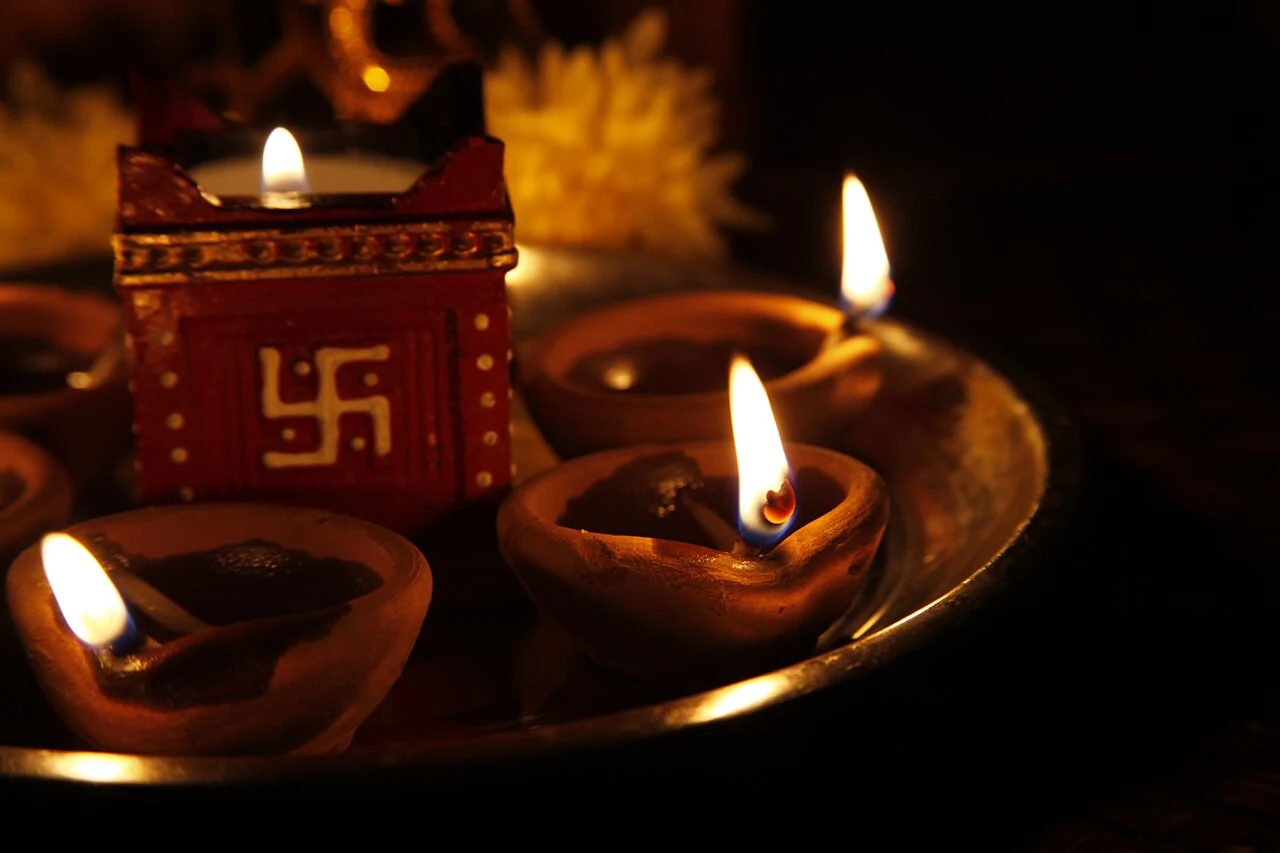
Lights, worship, family gathering and new beginnings take different forms. Traditions connect the season with Rama, Lakshmi, Krishna and other narratives; Jain and Sikh observances also fall in this period with distinct meanings.
Mythological story & sacred tradition
Festival and scriptural traditions
Several stories behind the lamps
In a widespread northern tradition, lamps welcome Rama, Sita and Lakshmana home after exile. Other communities emphasise Lakshmi, new beginnings or Krishna’s defeat of Narakasura. These are overlapping regional explanations, not one account followed everywhere.
The Bhagavata Purana narrates Krishna’s expedition against Naraka with Satyabhama. It is a source for that divine episode; the whole present-day Diwali calendar is not described by that chapter alone. Jain and Sikh observances in the same season have their own sacred histories.
Dhanteras also has a sacred association with Dhanvantari. In the Bhagavata Purana’s ocean-churning narrative, Dhanvantari appears with the nectar vessel and is identified with medical knowledge (Book 8, chapter 8, verse 34). This is a scriptural account, not documentary evidence for the origin of medicine.
What makes it special
Diwali’s richness lies in the variety of meanings attached to lamps, worship, hospitality and renewal across communities.
Dhanteras: the beginning of the season
Dhanteras, also called Dhantrayodashi, opens the Diwali season in many communities. Buying utensils or precious metals is a customary expression of hope for prosperity, not a requirement for participation or a promise of financial gain. Cleaning, lighting lamps and gathering with family are also ways people mark renewal.
The Controller of Communication Accounts, Bihar, lists Dhanteras on 6 November in its 2026 restricted-holiday calendar. This is a dated administrative source, not a nationwide puja timetable. The same calendar lists Diwali on 8 November. Check the local temple or community calendar for ritual timings.
Different regions, different sequences
A familiar account of the season connects Dhanteras, Naraka Chaturdashi, Lakshmi worship, Govardhan Puja or Balipratipada, and Bhai Dooj. That outline should not be treated as five identical civil dates or practices throughout India. Lunar intervals and regional rules can place observances differently.
Maharashtra Tourism describes Vasubaras as a preceding celebration, Balipratipada or Padwa as honouring King Bali, and Bhaubeej as a celebration of the sibling bond. These regional names make the season more understandable than a single nationwide checklist. Ask which tradition a programme follows before interpreting its dates.
A public-holiday list answers when an office closes; a religious calendar answers a different question about observance. If two lists disagree, compare their year, location and purpose rather than automatically treating one as a calculation error. Our dated calendar identifies its source; the interactive Panchang explains the astronomical elements but does not prescribe every festival.
How to confirm the date
The customary season above is a guide, not a current event booking. Some observances follow a lunar tithi or star; others follow a solar calendar or an organiser’s announced schedule. Use the official event programme or religious authority for the final date and any change of venue.
Read the official account
Getting there
This celebration has no single venue. Confirm the town, temple or event ground with the organiser before choosing a railway station or airport.
References & further reading
- Official information · incredibleindia.gov.in
Government or organiser information. Recheck the announced date, venue and public-access arrangements. - Controller of Communication Accounts, Bihar · 2026 holidays
Lists Dhanteras on 6 November and Diwali on 8 November; administrative dates, not local muhurta instructions. Checked 1 November 2026. - Maharashtra Tourism · Diwali
Regional sequence, including Vasubaras, Padwa and Bhaubeej; not a current local ritual timetable. - Bhagavata Purana · Book 10, chapter 59
Krishna’s defeat of Naraka; regional festival associations are described separately. - Bhagavata Purana · 8.8.34
Dhanvantari within the ocean-churning narrative; this verse does not establish a modern festival date. - Press Information Bureau · Dhanteras greeting, 10 November 2023
A contemporary example of the devotional association between Dhanteras and Dhanvantari; not a source for the 2026 festival date.