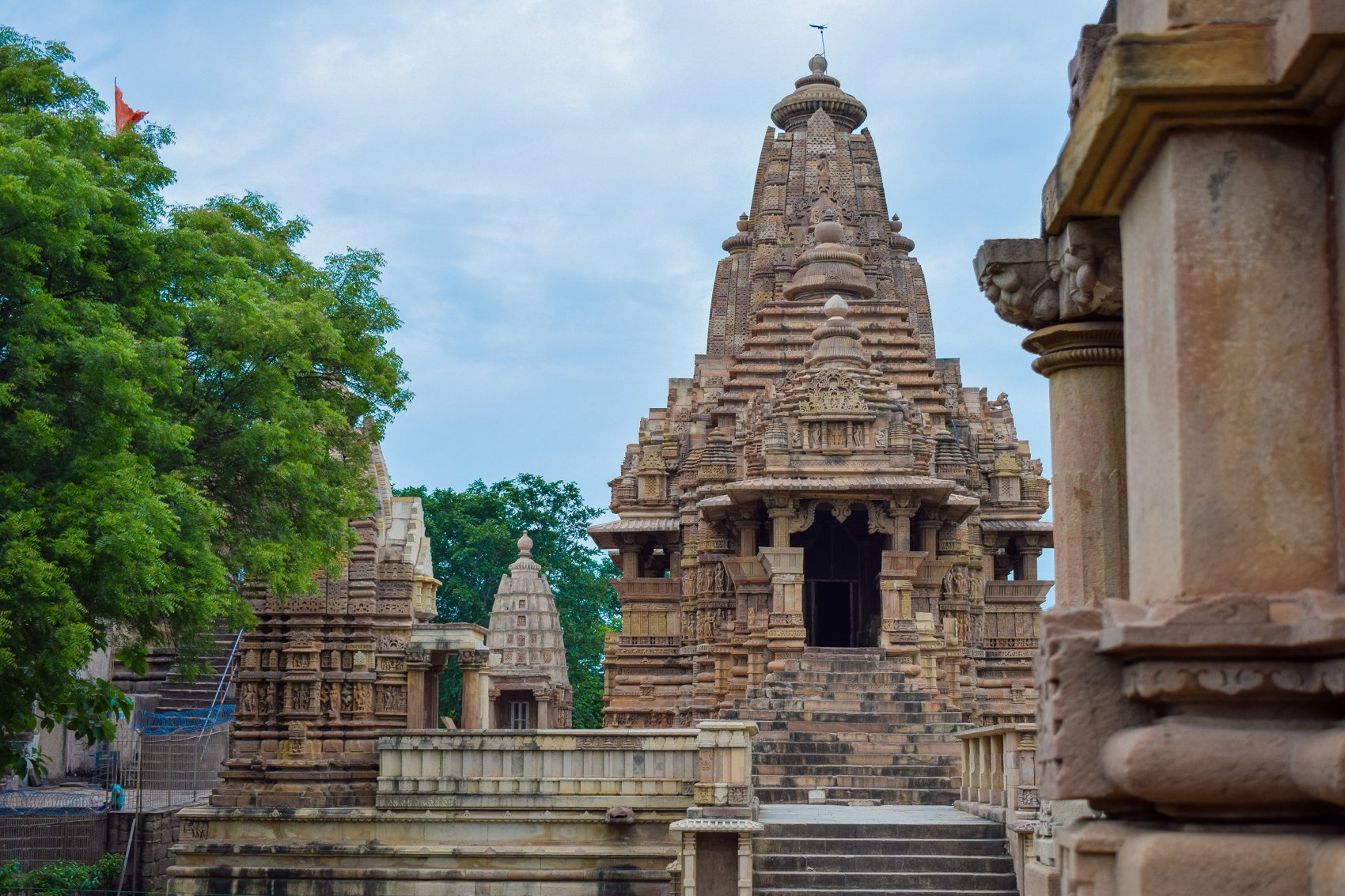
Many forms, different understandings
Hindu traditions include worship of a supreme personal deity, multiple deities, an ultimate reality beyond form, and philosophies that do not centre a creator god. A family may honour a chosen deity, a village guardian and other divine forms without seeing a contradiction. Names, images, narratives and regional traditions make devotion locally meaningful.
For some, divine forms express one ultimate reality; for others, differences between God, souls and the world are real and enduring. Advaita, Vishishtadvaita and Dvaita are not interchangeable explanations. A murti functions within consecrated worship as a focus of divine presence, not merely as decoration.
The Trimurti: Brahma, Vishnu and Shiva
The familiar Trimurti associates Brahma with creation, Vishnu with preservation and Shiva with dissolution and transformation. These roles are a useful introduction, but they do not establish an identical hierarchy for all communities. Brahma is a deity; brahman is a philosophical term for ultimate reality.
Vaishnava traditions centre Vishnu or Krishna; Shaiva traditions centre Shiva; Shakta traditions centre Devi as supreme. Brahma has fewer major centres of active worship than Vishnu or Shiva. Pushkar is famous, but the assertion that it is the only Brahma temple is incorrect.
The goddess and other beloved forms
Saraswati is associated with learning and the arts; Lakshmi with prosperity and auspiciousness; Parvati with Shiva and the many powers of Devi. Durga and Kali express powerful forms of the goddess in particular narratives and practices. Ganesh is widely approached at beginnings, while Kartikeya or Murugan has especially strong regional devotional traditions. Hanuman represents devotion, courage and service in the Ramayana world.
These brief associations are not complete definitions. Deities’ meanings change across texts, languages, temples and families. “Thirty-three crore gods” is a popular expression; ancient classifications of thirty-three deities and later expansive enumerations belong to different contexts. A single fixed census of Hindu gods is not possible.
What is an avatar?
Avatara means a descent or manifestation, especially of Vishnu in many Vaishnava traditions. It is different from simply counting another independent god. The Gita 4.7–8 connects divine manifestation with the restoration of dharma. Lists vary: the familiar Dashavatara is influential but does not exhaust all avatars described in texts.Shiva and Devi also have manifestations and forms, but a uniform set of ten avatars for each is not shared by all traditions. Krishna is an avatar of Vishnu in many accounts; some Krishna-centred traditions regard Krishna as the original supreme form from whom others proceed.
Avatars and the four yugas
Yugas are cycles within religious cosmology, not archaeological period labels. The sequence is Satya or Krita, Treta, Dvapara and Kali. The following is a common devotional arrangement; the details and lists vary.
| Yuga | Common associations | How to read the account |
|---|---|---|
| Satya / Krita | Matsya, Kurma, Varaha and Narasimha | Preservation, cosmic support, rescue of the Earth and protection of devotion. |
| Treta | Vamana, Parashurama and Rama | Accounts explore power, humility, kingship and dharma. |
| Dvapara | Krishna; Balarama in some lists | Krishna’s life, the Mahabharata and teachings of the Gita. |
| Kali and its ending | Buddha in some Hindu lists; Kalki as a future avatar | Buddhists do not generally understand the Buddha as Vishnu’s avatar. Kalki belongs to future religious expectation, not a scientifically dated prediction. |
How does this differ from other religions?
Distinctive features of many Hindu traditions include karma and rebirth, several paths to liberation, extensive narrative cycles, and varied relationships between divine unity and plurality. These do not make all Hindus alike. Other religions are also internally diverse, and some concepts overlap with Buddhist, Jain or other traditions.
A respectful comparison considers a specific teaching or practice. It avoids ranking religions or claiming that only one tradition values peace, inquiry or compassion. Explore India’s religious diversity.
Sources & further reading
Read the evidence and traditions behind this guide.