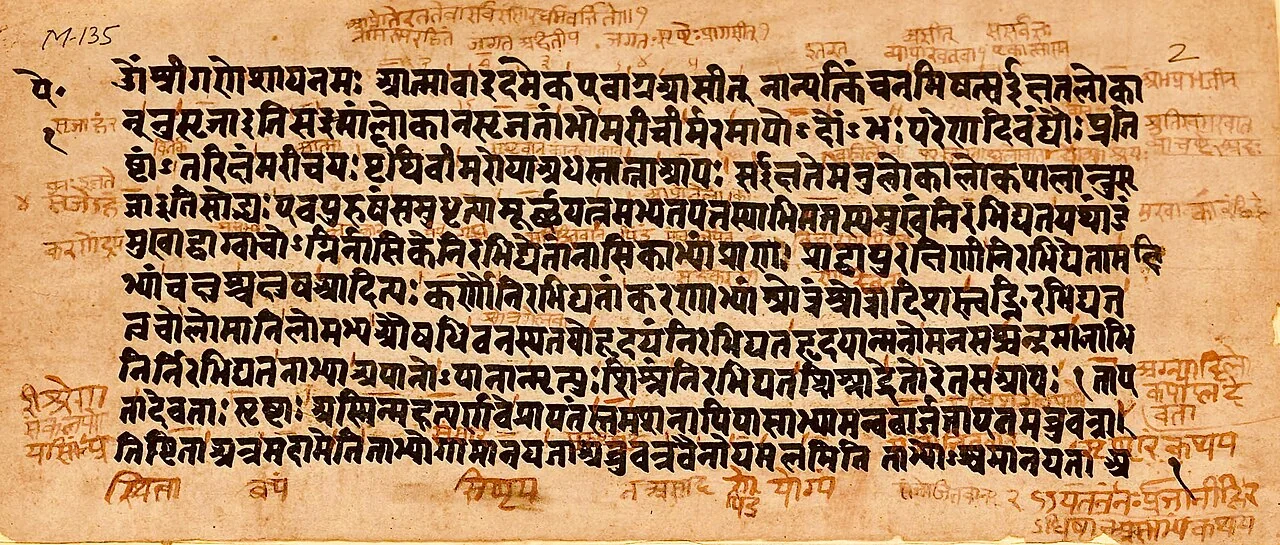
One tradition, several collections
The Upanishads are a varied body of philosophical and religious works associated with Vedic learning. Early prose texts and many later works differ in date, style and teaching. The Muktika enumerates 108; this is a traditional canon, not a count of every text ever called an Upanishad. The wider corpus includes additional works.
Thirteen widely studied texts
| Upanishad | Questions to follow |
|---|---|
| Isha | How renunciation, action and the presence of the divine are related. |
| Kena | What enables seeing, hearing and thought, and why ultimate reality exceeds ordinary possession of knowledge. |
| Katha | Nachiketas questions Yama about death, the self and the difference between what is pleasant and what is good. |
| Prashna | Six questions explore life, breath, meditation and the foundations of experience. |
| Mundaka | A distinction between kinds of knowledge leads to a discussion of brahman and liberation. |
| Mandukya | A short exploration of Om, waking, dream, deep sleep and the “fourth,” later interpreted through influential commentary. |
| Taittiriya | Learning, ethical responsibilities, food, life and layered descriptions of the person. |
| Aitareya | Creation, consciousness and inquiry into the self. |
| Chandogya | Teachings framed through chant, dialogue and examples such as the relation between a subtle essence and the visible world. |
| Brihadaranyaka | Expansive dialogues about the self, knowledge and liberation, including debates involving Yajnavalkya, Gargi and Maitreyi. |
| Shvetashvatara | Meditation, divine power and the relation between the individual, the world and a supreme principle. |
| Kaushitaki | Breath, consciousness and the journey of the self in a Rigvedic setting. |
| Maitri / Maitrayaniya | The self, mind, time and disciplines of contemplation in a text with layered development. |
The 108-name Muktika index
Names are given in accessible Roman spelling; editions use variant spellings and occasionally different title forms. The index names the traditional corpus; it does not imply that all 108 texts have equal antiquity or one identical philosophy.
- Isha
- Kena
- Katha
- Prashna
- Mundaka
- Mandukya
- Taittiriya
- Aitareya
- Chandogya
- Brihadaranyaka
- Brahma
- Kaivalya
- Jabala
- Shvetashvatara
- Hamsa
- Aruneya
- Garbha
- Narayana
- Paramahamsa
- Amritabindu
- Amritanada
- Atharvashiras
- Atharvashikha
- Maitrayani
- Kaushitaki
- Brihajjabala
- Nrisimhatapaniya
- Kalagnirudra
- Maitreyi
- Subala
- Kshurika
- Mantrika
- Sarvasara
- Niralamba
- Shukarahasya
- Vajrasuchika
- Tejobindu
- Nadabindu
- Dhyanabindu
- Brahmavidya
- Yogatattva
- Atmabodha
- Naradaparivrajaka
- Trishikhibrahmana
- Sita
- Yogachudamani
- Nirvana
- Mandalabrahmana
- Dakshinamurti
- Sharabha
- Skanda
- Mahanarayana
- Advayataraka
- Ramarahasya
- Ramatapaniya
- Vasudeva
- Mudgala
- Shandilya
- Paingala
- Bhikshuka
- Mahat / Maha
- Shariraka
- Yogashikha
- Turiyatita
- Sannyasa
- Paramahamsaparivrajaka
- Akshamalika
- Avyakta
- Ekakshara
- Annapurna
- Surya
- Akshi
- Adhyatma
- Kundika
- Savitri
- Atma
- Pashupatabrahma
- Parabrahma
- Avadhuta
- Tripuratapini
- Devi
- Tripura
- Katharudra
- Bhavana
- Rudrahridaya
- Yogakundalini
- Bhasmajabala
- Rudrakshajabala
- Ganapati
- Darshana
- Tarasara
- Mahavakya
- Panchabrahma
- Pranagnihotra
- Gopalatapaniya
- Krishna
- Yajnavalkya
- Varaha
- Shatyayaniya
- Hayagriva
- Dattatreya
- Garuda
- Kalisantarana
- Jabali
- Saubhagyalakshmi
- Sarasvatirahasya
- Bahvricha
- Muktika
Yoga, renunciation and devotional Upanishads
Later groups explore yoga, ascetic renunciation, Vishnu, Shiva, Devi and other themes. These categories overlap. Some texts use Upanishadic language to present a particular devotional path as the highest knowledge. Their value to a community does not depend on placing them all in the earliest Vedic period.
Brahman, atman and interpretation
Brahman can refer to ultimate reality; atman to the self. Their relationship is interpreted differently by Advaita, Vishishtadvaita, Dvaita and other traditions. Translating either term into one familiar English word can hide the argument. Compare commentaries and keep a distinction between the wording of a passage and a later philosophical system.
Where to read
The government’s Vedic Heritage Portal offers introductions and selected texts. The linked Sanskrit Documents index is useful for locating primary texts; consult its terms before reproducing editions or translations. This page provides original introductions and a title index, not complete translations of the corpus.
Sources & further reading
Read the evidence and traditions behind this guide.