Official website and visitor information
The archaeological site, museum and living monasteries are distinct places with their own visiting arrangements.
Varanasi district · Sarnath travel information · Ministry of Tourism · regional seasons and Buddha Purnima
The turning of the wheel
Buddhist tradition remembers Sarnath as the place where the Buddha first taught after his enlightenment. The event is described as setting the wheel of Dharma in motion: a teaching begins to circulate through a community rather than remaining an individual discovery. Bodh Gaya and Sarnath therefore mark different moments in the sacred narrative.
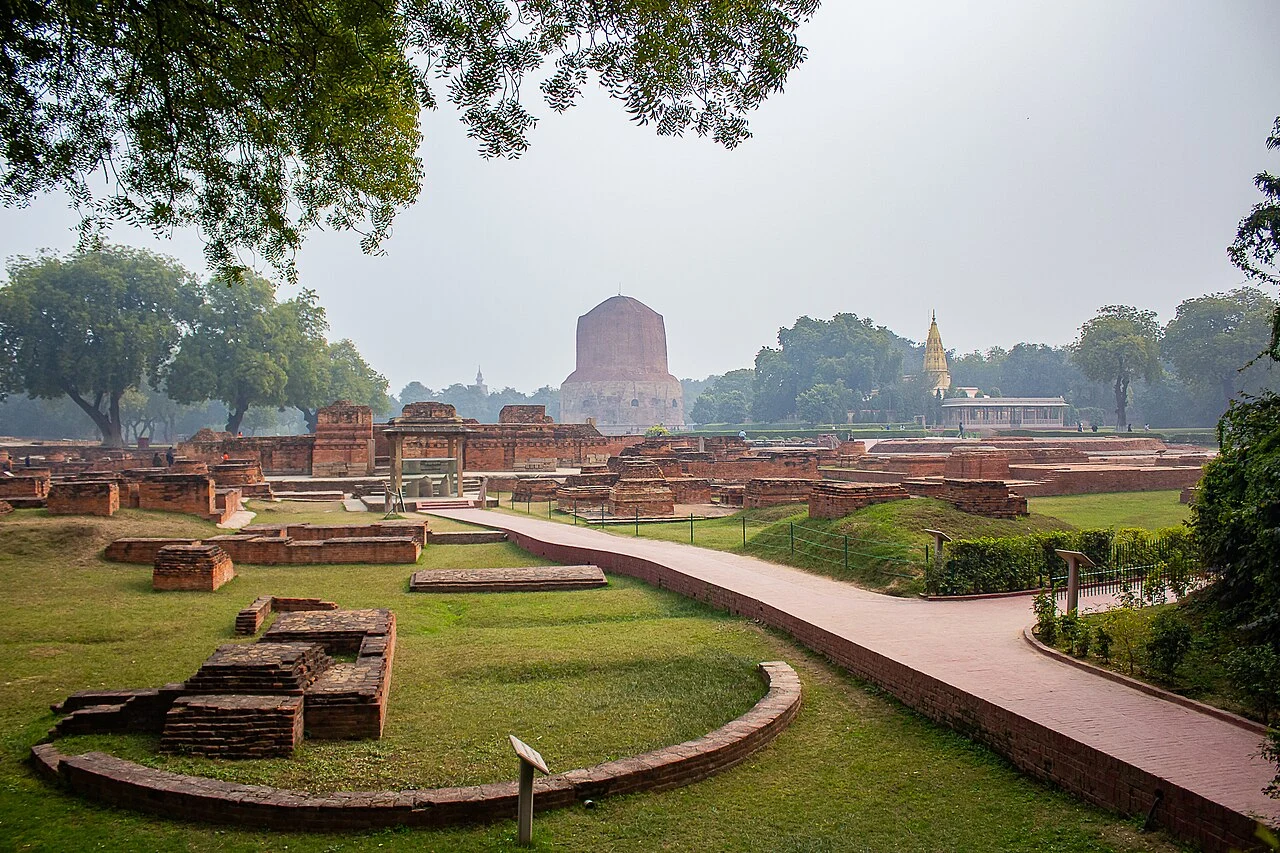
The surviving remains document centuries of patronage and worship. Varanasi’s district administration describes antiquities extending from the time of Ashoka to the twelfth century. They are evidence of the place’s long Buddhist history, rather than a complete surviving setting from the day of the first sermon.
Stupa, sculpture and a national emblem
The massive Dhamekh Stupa is an important landmark; its lower portion carries finely worked floral carving. Remains of monasteries and other shrines reveal that Sarnath was a religious settlement, not simply an isolated monument. The Chaukhandi Stupa and the Mahabodhi Society’s Mulagandha Kuti Vihar add other layers to a visit.
Set aside time for the archaeological museum as well as the outdoor remains. The lion capital associated with Ashoka’s pillar at Sarnath inspired India’s national emblem. Seeing sculpture in a museum can change the way you understand the ruins: a fragment that seems small in a landscape may contain an exceptionally detailed artistic or political message.
Make it a two-part visit
Check current arrangements for the archaeological area and museum separately; they should not be assumed to share every opening day, ticket or photography rule. Read the labels for the objects you encounter and avoid climbing ancient masonry. At functioning places of worship, follow the attendants’ directions and leave space for prayer. Pairing the historical remains with living worship helps explain why Sarnath is meaningful to both pilgrims and readers interested in Indian art.
Getting there
Sarnath
- Local / nearest rail approach
- Sarnath railway station
- Major long-distance railway option
- Varanasi Junction (Cantt)
- Nearest airport / regional flight gateway
- Lal Bahadur Shastri International Airport, Varanasi (VNS)
Sarnath is the local station; use Varanasi Junction for a wider choice of long-distance trains. Confirm that your train stops at Sarnath.
Travel source: Varanasi district · Sarnath travel information · Ministry of Tourism · regional seasons and Buddha Purnima
Varanasi district · Sarnath travel information
Best time to visit
October–March follows the official recommended season for the Varanasi region.
Festivals & occasions: Buddha Purnima is a major Buddhist occasion, generally in April–May; confirm the local monastery programme.
Season & festival references: Varanasi district · Sarnath travel information · Ministry of Tourism · regional seasons and Buddha Purnima
Reviewed 21 November 2026. Seasonal windows are guidance; confirm weather, access and the current event programme before booking.
Arrival points apply to the named approach. A gateway is a practical travel option, not a claim that it is the closest stop. Confirm passenger services and the onward transfer before booking.
Sources & further reading
Read the evidence and traditions behind this guide.
Official district information · Google Maps · Explore sacred places