Official website and visitor information
This monument appears in the Ministry of Culture’s list of ASI ticketed monuments. Visitor categories and any additional admission are determined by the booking portal.
Ministry of Culture · ticketed monuments
Use the ASI portal to select this monument, the date and the applicable visitor category. Check the current admission price and any separate museum or special-access ticket before paying.
A complex, not only a tower
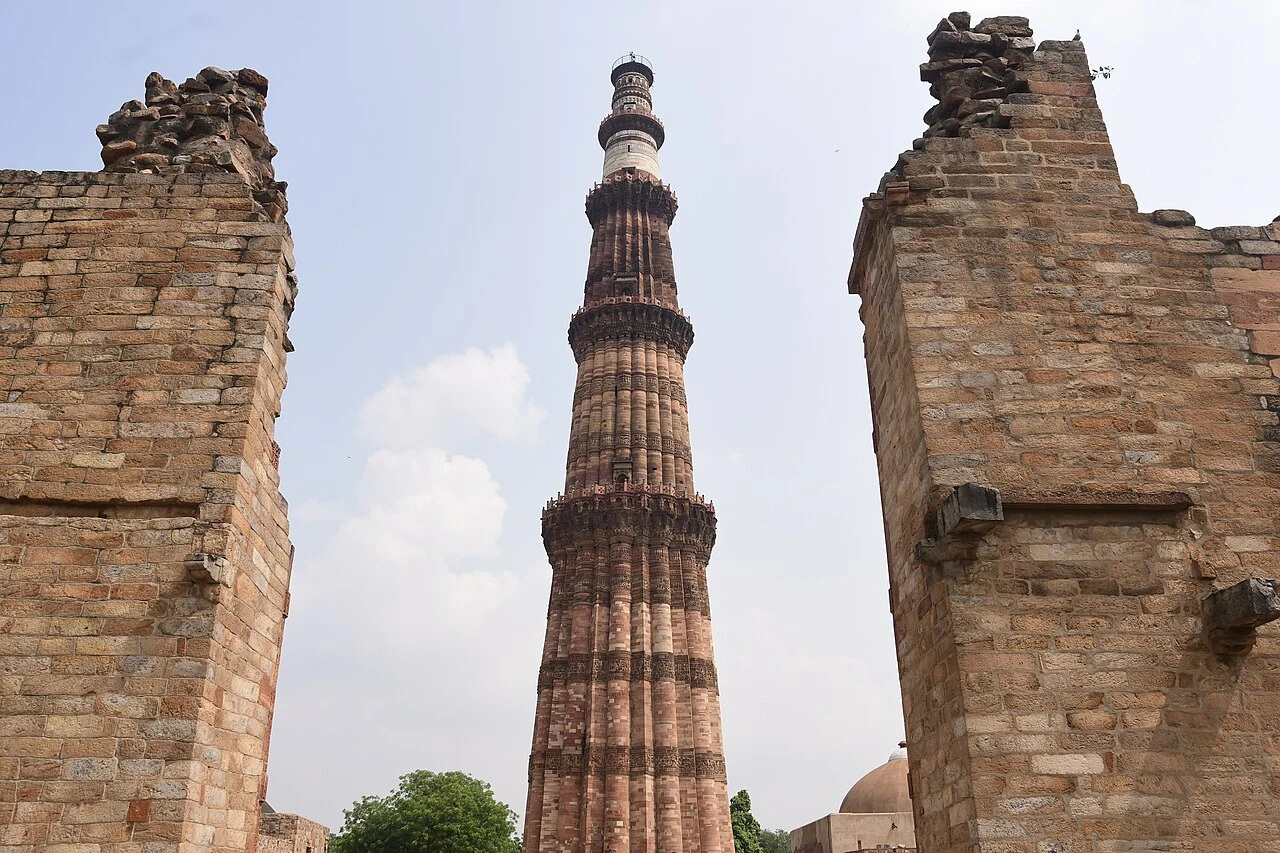
The Qutb complex at Mehrauli is one of the strongest places to begin exploring the Delhi Sultanate. The minaret rises about 72.5 metres, but its surroundings matter equally: mosque remains, tombs and gateways document successive building campaigns. The UNESCO description draws attention to its fluted surfaces and the Alai Darwaza, constructed in 1311. Rather than imagining a finished project by one ruler, look for additions and changes over time.
How to read the stone
Delhi Tourism records that Qutb-ud-din Aibak began the minaret and Iltutmish added further storeys; later repairs form another part of its history. Compare the tower’s bands of inscription and ornament with the carved columns around the mosque. Reused material from earlier Hindu and Jain structures is part of the complex’s documented history. Explain this evidence in the context of specific buildings and patrons, rather than assigning actions to whole present-day religious communities.
The iron pillar and a wider timeline
The iron pillar belongs to an earlier period than the Sultanate structures around it. Its presence is a reminder that an archaeological site can contain objects of different ages and origins. The useful question is not simply which feature is oldest, but how objects, inscriptions and structures help reconstruct changes in a place. Read the official interpretation before accepting dramatic claims about impossible technology or secret construction methods.
Planning the visit
Approach the site as an outdoor reading room: pause at the tower, gateway and mosque remains, and compare the official map with what survives. Staying on visitor paths helps protect fragile surfaces. Do not assume that a prominent doorway, stairway or fenced monument is open to visitors. Confirm current access arrangements, tickets and mobility needs with the official visitor information. The map below is a location aid; the ticketing and entry instructions at the site take precedence.
Getting there
Qutb Minar, Mehrauli
- Local railway option
- Hazrat Nizamuddin railway station
- Major long-distance railway option
- New Delhi railway station
- Airport gateway
- Indira Gandhi International Airport, Delhi (DEL)
These are city railway gateways, not Metro stations or a measured closest-stop ranking. Use local transport for the final approach.
Travel source: Official destination and visitor guide · Incredible India · Delhi travel information
Official destination and visitor guide
Best time to visit
October–March: the cooler Delhi season is generally better for outdoor sightseeing; check local weather and air-quality advisories.
Season & festival references: Official destination and visitor guide · Incredible India · Delhi travel information
Reviewed 21 November 2026. Seasonal windows are guidance; confirm weather, access and the current event programme before booking.
Arrival points apply to the named approach. A gateway is a practical travel option, not a claim that it is the closest stop. Confirm passenger services and the onward transfer before booking.
Sources & further reading
Read the evidence and traditions behind this guide.
Official information & map
Official visitor information / read more · Open location in Google Maps
Official sources reviewed in October 2026. Recheck access and operational notices before travel.