Official website and visitor information
This monument appears in the Ministry of Culture’s list of ASI ticketed monuments. Visitor categories and any additional admission are determined by the booking portal.
Ministry of Culture · ticketed monuments
Use the ASI portal to select this monument, the date and the applicable visitor category. Check the current admission price and any separate museum or special-access ticket before paying.
A city shaped by an imperial court
Emperor Akbar founded Fatehpur Sikri as a Mughal capital in the sixteenth century. The Agra district administration dates its foundation to 1571. Its period as the principal capital was relatively brief, but its surviving buildings preserve an unusually coherent ensemble of courtly and religious architecture. Read it as a city of different activities and communities, not simply one palace or a deserted backdrop.
Architecture that changes with its purpose
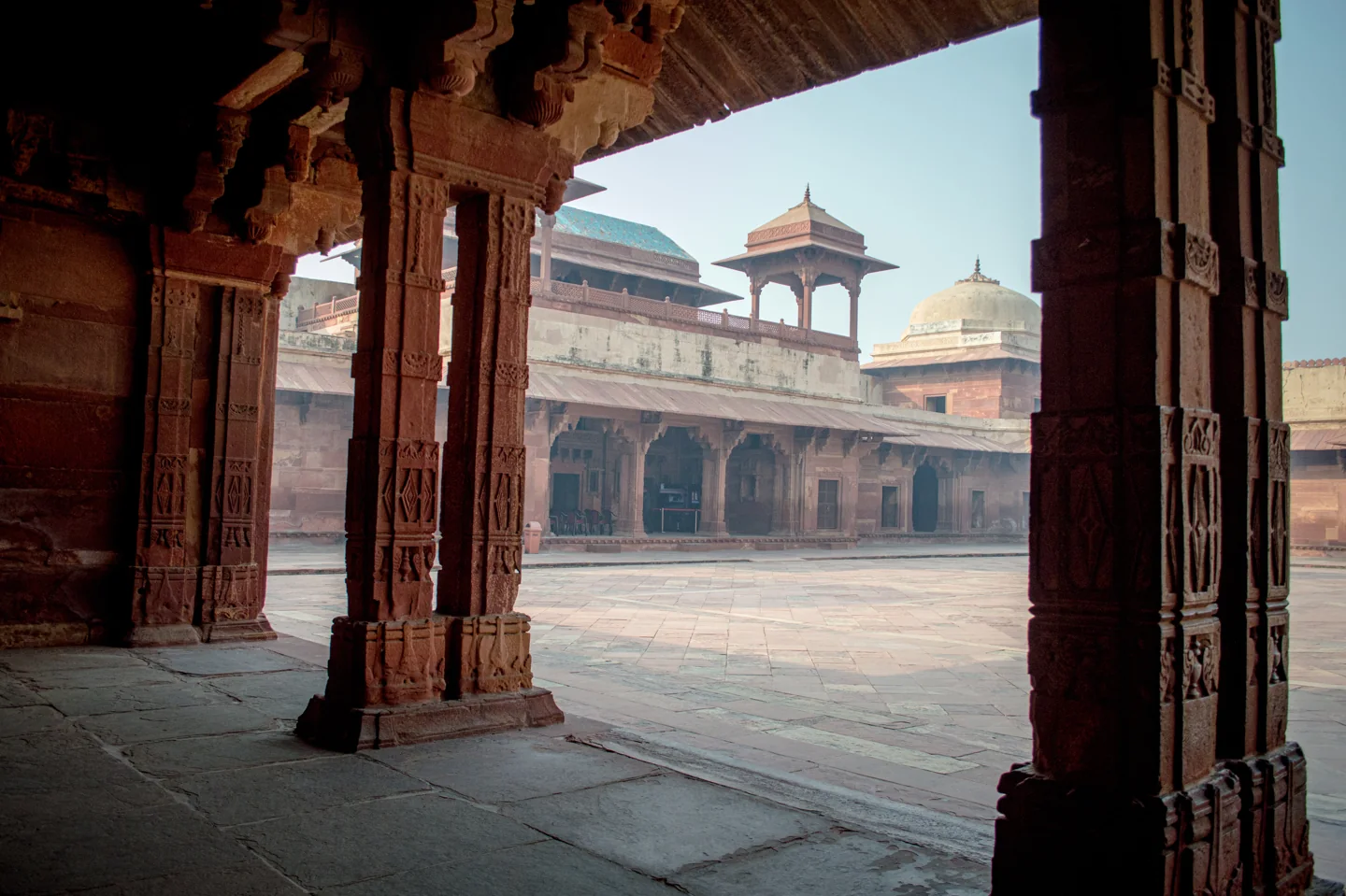
The district’s guide highlights the Panch Mahal, Diwan-i-Khas, Jama Masjid, Buland Darwaza and the marble tomb of Sheikh Salim Chishti. Together they demonstrate a range of scales, from open pavilions to monumental gateways. UNESCO explains the combination of local and Persian architectural forms and identifies richly carved pillars, balconies and pierced stone screens. Compare the airy, columned Panch Mahal with the enclosing spaces of the residential buildings. That comparison helps make the architecture understandable without needing to memorise every building name.
Sacred space within an imperial landscape
The mosque and the tomb of the Sufi saint Sheikh Salim Chishti are central to the site’s identity. Their religious significance should be approached alongside the history of Akbar’s court. UNESCO records successive phases of construction and embellishment, reminding visitors that even a visually unified place can contain changes over time. Devotional practice at a shrine is a living tradition; historical claims about the city should be grounded in inscriptions, buildings and documented scholarship.
How to explore thoughtfully
Plan around two complementary experiences: the courtly buildings and the mosque-and-shrine precinct. At each, observe how an approach, threshold and courtyard shape movement. Ask before photographing worshippers and follow the rules of sacred spaces. Confirm current entry arrangements with the responsible authorities rather than assuming one ticket or entrance covers everything. The official district page is a useful orientation; the UNESCO record provides a more detailed architectural account. A slower visit makes space to notice workmanship beyond the best-known gateway.
Getting there
Fatehpur Sikri
- Local railway option
- Fatehpur Sikri railway station
- Major long-distance railway option
- Agra Cantonment
- Airport gateway
- Agra Airport (AGR)
Fatehpur Sikri has limited local rail options. Agra Cantonment is the major arrival for an onward road transfer.
Travel source: Official destination and visitor guide · UP Tourism · Agra access · Government of Uttar Pradesh · regional season
Official destination and visitor guide
Best time to visit
October–March: the cooler Agra season is more comfortable for the open courtyards and walking routes.
Season & festival references: Official destination and visitor guide · UP Tourism · Agra access · Government of Uttar Pradesh · regional season
Reviewed 21 November 2026. Seasonal windows are guidance; confirm weather, access and the current event programme before booking.
Arrival points apply to the named approach. A gateway is a practical travel option, not a claim that it is the closest stop. Confirm passenger services and the onward transfer before booking.
Sources & further reading
Read the evidence and traditions behind this guide.
Official information & map
Official information / read more · Open location in Google Maps
Sources reviewed in October 2026. Confirm current visitor access with the responsible authority before travelling.