Official website and visitor information
This monument appears in the Ministry of Culture’s list of ASI ticketed monuments. Visitor categories and any additional admission are determined by the booking portal.
Ministry of Culture · ticketed monuments
Use the ASI portal to select this monument, the date and the applicable visitor category. Check the current admission price and any separate museum or special-access ticket before paying.
A monument made for water
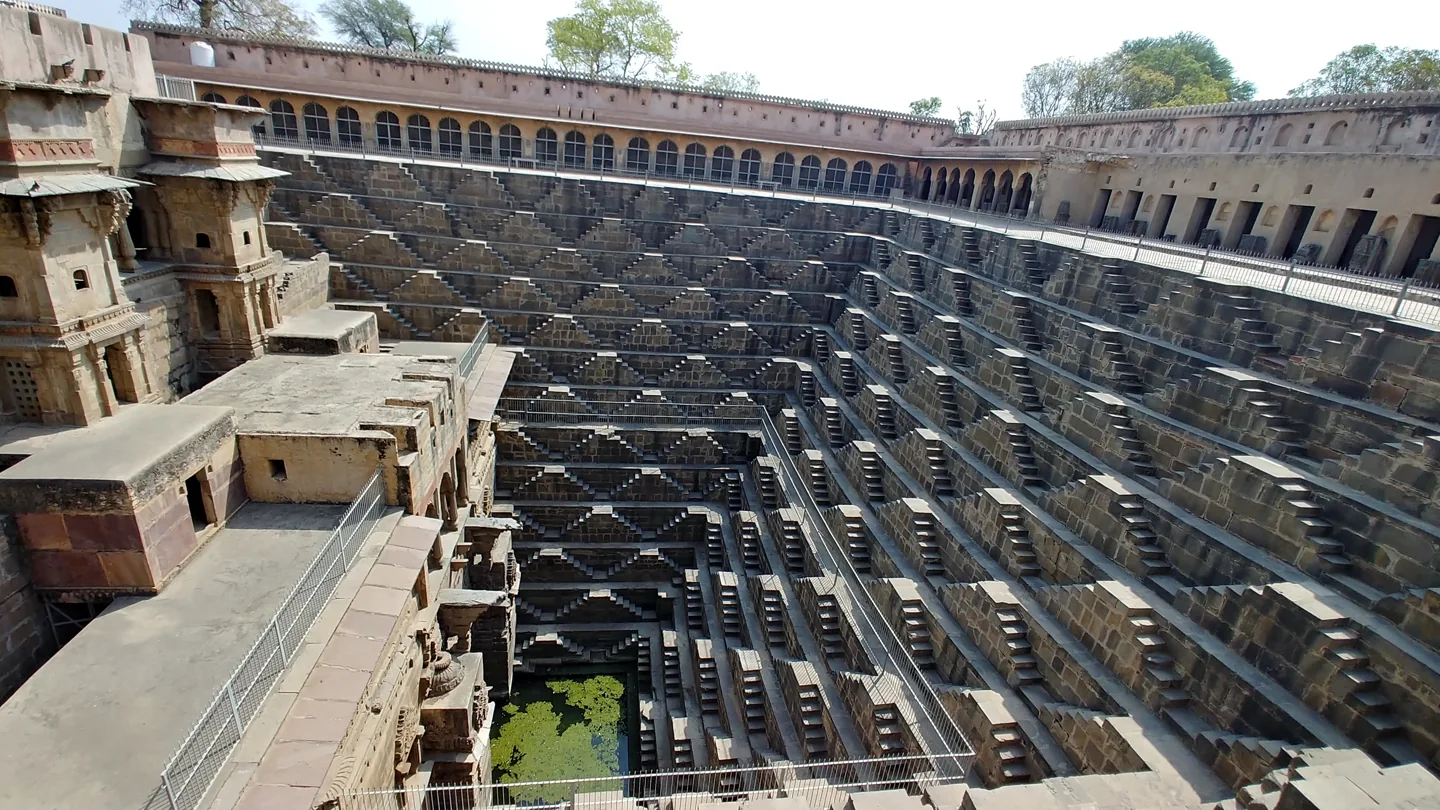
Chand Baori stands in Abhaneri, in Rajasthan’s Dausa district. Rajasthan Tourism attributes it to King Chanda of the Nikumbha dynasty in the ninth century. Its defining purpose was to conserve water, while the deeper spaces offered relief from the heat and a place for gathering. Read that practical function first: the repeated steps were part of an approach to water, rather than decoration added to a conventional building.
Geometry, light and a pavilion
Three sides of the well descend through a dense pattern of stairways. The fourth has a pavilion with carved windows, galleries and balconies. Rajasthan Tourism describes 3,500 steps, but the experience is more than a number: diagonal lines intersect with horizontal landings, and shadows change the apparent depth. Compare the rhythm of the steps with the more enclosed spaces of the pavilion. This contrast gives the structure both its clarity and its intricacy.
Looking closely without losing the whole
Begin from a permitted viewpoint where you can take in the complete well. Then choose a smaller detail: a stair junction, a carved opening or the meeting of two walls. Ask how a person would move through the structure as the water level changed. Such questions turn a geometric photograph into an encounter with design. Nearby Harshat Mata Temple belongs to the wider historic setting, although the stepwell is the focus of this guide.
A thoughtful visit to Abhaneri
Use the state tourism page to plan the approach, and follow the monument’s current access instructions when you arrive. An old photograph of someone on the steps does not establish that descent is permitted today. Keep clear of barriers and allow other visitors room at viewing points. Take time to observe the structure from more than one angle instead of trying to reproduce a single familiar image. Bring water for your own visit; the historic well is a heritage site, not a drinking-water stop.
Getting there
Abhaneri
- Local railway option
- Bandikui Junction
- Major long-distance railway option
- Jaipur Junction
- Airport gateway
- Jaipur International Airport (JAI)
Bandikui is the local rail approach; Jaipur offers a wider city transport hub.
Travel source: Official destination and visitor guide · Ministry of Tourism · Abhaneri Festival · RTDC · best time to visit
Official destination and visitor guide
Best time to visit
October–March: Rajasthan’s cooler season is more comfortable for outdoor sightseeing.
Festivals & occasions: The Abhaneri Festival celebrates local performing arts; check the current announced programme.
Season & festival references: Official destination and visitor guide · Ministry of Tourism · Abhaneri Festival · RTDC · best time to visit
Reviewed 21 November 2026. Seasonal windows are guidance; confirm weather, access and the current event programme before booking.
Arrival points apply to the named approach. A gateway is a practical travel option, not a claim that it is the closest stop. Confirm passenger services and the onward transfer before booking.
Sources & further reading
Read the evidence and traditions behind this guide.
Official information & map
Read more · Official visitor information · Open location in Google Maps
Sources reviewed in October 2026. Confirm current access, entry arrangements and notices before travelling.