A powerful metaphor, not a balance sheet
“Sone ki Chidiya,” the golden bird, evokes abundance and cultural prestige. Across different periods, parts of the subcontinent produced valued textiles, spices, metals, agricultural surpluses and intellectual work. This did not mean that every person was wealthy, that borders matched modern India, or that prosperity remained unchanged.
Claims that India held a precise share of world GDP in antiquity rely on later reconstructions, not contemporary national accounts. Estimates depend on population assumptions, geographic boundaries and sparse evidence. Economic achievement is better introduced through identifiable industries, ports and institutions than through a single triumphant number.
Goods that travelled across oceans
Harappan seals, weights and material finds show long-distance exchange, including connections with Mesopotamia. In the early centuries CE, ports on the western and southern coasts participated in Indian Ocean trade. Pepper, textiles, beads, ivory and other goods moved through networks involving Indian, Arab, East African and Mediterranean merchants. Roman coins and imported ceramics are important evidence, although a coin’s presence alone does not reveal an entire trading system.
Later textile production in Gujarat, the Coromandel region and Bengal supplied extensive overseas markets. Indian Ocean commerce carried more than goods: scripts, religious ideas, languages, stories and technologies travelled with people. Trade was reciprocal; the subcontinent received knowledge and commodities as well as exporting them.
Takshashila: a centre of teachers and learning
Takshashila, or Taxila, lies in present-day Pakistan and belongs to the shared history of the ancient subcontinent. Textual traditions associate it with advanced study and famous teachers. Its archaeological landscape includes urban settlements and Buddhist monasteries shaped by several political and cultural worlds.
Calling Taxila a university can help a modern reader recognise its scholarly importance, but it was not necessarily a single centralised degree-granting institution like a modern university. Stories linking particular figures to Taxila must be assessed individually rather than treated as a surviving enrolment register.
Nalanda: a residential scholarly community
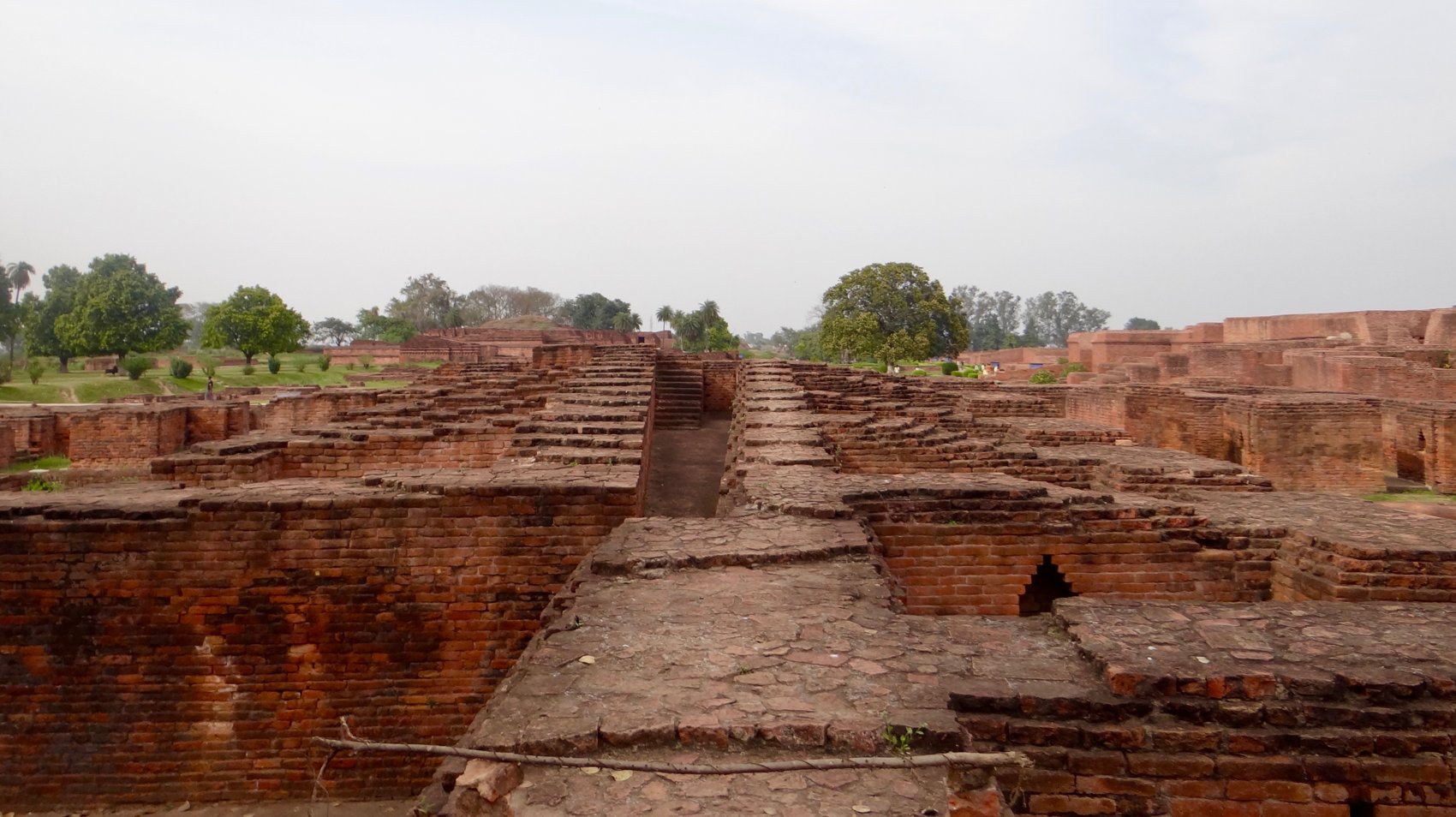
Nalanda Mahavihara in Bihar grew into a major Buddhist monastic and educational centre, flourishing for centuries from the first millennium CE. Excavated monasteries, shrines and sculptures reveal an extensive residential environment. Buddhist philosophy was central; accounts also describe engagement with logic, grammar and other branches of learning.
Chinese monks Xuanzang and Yijing are important witnesses to scholarly travel and translation. Their journeys involved religious commitment, difficult routes and patronage; they were not simply foreign “students sent by kings.” Royal support mattered, but individual motives varied. Nalanda’s decline and destruction occurred within a longer history of changing patronage and political violence; dramatic stories about library fires lasting a precise number of months require source criticism.
A wider educational landscape
Vikramashila, Valabhi, Odantapuri, Kanchipuram and numerous monasteries, temples, courts and teacher households formed a varied learning landscape. Manuscripts, memorisation, commentary, debate and apprenticeship served different purposes. Artisans also transmitted sophisticated knowledge through practice.
Access was unequal: caste, gender, wealth, location and patronage affected who could study and what they could learn. Remembering intellectual achievement should include the labour that sustained institutions and people whose contributions were rarely recorded.
Mathematics, astronomy and language
Aryabhata’s work in the fifth–sixth centuries CE included mathematical astronomy and a discussion of Earth’s rotation. Brahmagupta formulated influential rules involving zero and negative numbers in the seventh century. Decimal place-value notation developed through a long history and travelled through Arabic-language scholarship to wider audiences. No single slogan about “inventing all mathematics” does justice to this process.
Panini’s analysis of Sanskrit used an exceptionally systematic grammar. The Kerala school later developed important infinite-series techniques. These are specific accomplishments with texts and histories; they do not mean that modern computers, aircraft or all modern physics already existed in ancient India.
Works to begin with: Aryabhata’s Aryabhatiya, Brahmagupta’s Brahmasphutasiddhanta, Panini’s Ashtadhyayi and Jyesthadeva’s Yuktibhasa. Each lets readers explore a specific achievement and the reasoning behind it. Read the scholar profiles and highlighted major works.
Medicine, materials and engineering
Texts associated with Charaka and Sushruta preserve important medical traditions, including descriptions of diagnosis, medicines and surgical techniques. Their historical importance is distinct from the question of whether a particular treatment meets modern clinical standards. Effectiveness and safety require evidence for the actual intervention.
Iron-working, crucible steel, zinc distillation, water systems, stone construction and textile production demonstrate sophisticated material knowledge in different regions and periods. For example, the Delhi iron pillar’s corrosion resistance is studied through metallurgy and environmental conditions. It is not evidence of supernatural technology.
The major medical compendia are the Charaka Samhita and Sushruta Samhita, associated respectively with internal medicine and a strong surgical tradition. Both reached us through layered transmission.
Visitors, translators and connected scholarship
Megasthenes represented Seleucus at the Mauryan court; his lost account survives in later quotations. Faxian, Xuanzang and Yijing travelled principally for Buddhist learning and texts. Al-Biruni studied Indian languages and thought in the eleventh century. These people were separated by centuries and cannot all be described as royal scholarship delegations.
Scholars also carried South Asian learning abroad. Kumarajiva, born in the Central Asian kingdom of Kucha to an Indian father and a Kuchean mother, became a major translator in China. Buddhist translators, merchants and monks helped build intellectual connections across Asia. Translation involved interpretation, disagreement and collaboration. India’s achievements become more meaningful when understood as part of a connected world.
Accounts to read: Megasthenes’ Indica survives in fragments quoted by later writers; Faxian’s Foguo Ji / A Record of Buddhistic Kingdoms describes his search for Buddhist discipline and texts; Xuanzang’s Great Tang Records of the Western Regions records places and religious communities encountered through his journey. These are valuable witnesses with particular aims and viewpoints.
From prosperity to colonial disruption and modern renewal
Political change, shifting commercial networks, European trading companies and colonial rule reshaped production and trade. Colonial extraction, unequal power and pressures on artisans were important, but regional experiences and timing differed. Avoid reducing several centuries to a single cause or treating the past as uniformly prosperous.
Today the strongest tribute to that inheritance is careful scholarship, accessible education, conservation and open exchange. Pride and critical thinking can support one another: evidence makes a remarkable history more credible.
Sources & further reading
Read the evidence and traditions behind this guide.
- UNESCO · Nalanda Mahavihara
- UNESCO · Taxila
- British Museum · Indian Ocean trade research
- British Museum · Money gallery
- University of St Andrews · Brahmagupta
- University of St Andrews · Aryabhata
- NCERT · Themes in Indian History
- IIT Kanpur · Gita Supersite and textual study
- Delhi Directorate of AYUSH · Classical compendia
- Faxian · A Record of Buddhistic Kingdoms
- University of Washington · Xuanzang’s Record of the Western Regions