Prehistoric worlds · Before c. 3300 BCE
Paint, stone and the beginnings of settlement
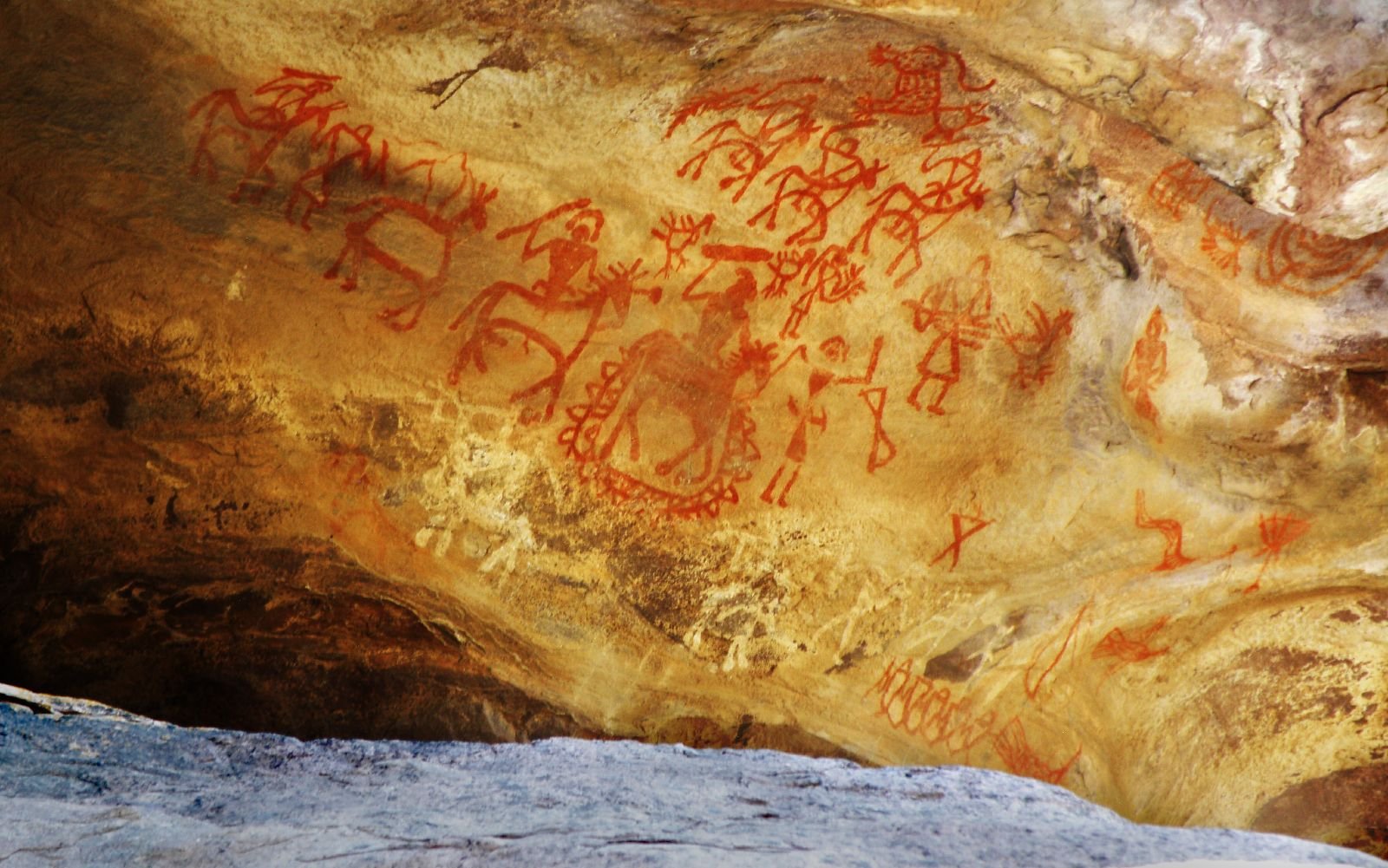
At rock shelters such as Bhimbetka, paintings made in different periods preserve animals, hunting, movement and community life. Not every image belongs to the same century or even the same way of life. Stone tools, food remains and habitation deposits let archaeologists study people whose words were never written down.
Art was part of inhabited landscapes. Later farming and pastoral communities made pottery and increasingly permanent settlements. Oral stories may have been important, but we cannot recover their exact words from material evidence. Archaeology must be distinguished from imaginative reconstructions of prehistoric religion.
Harappan cities · c. 2600–1900 BCE, mature phase
Urban craft and an undeciphered script
Harappa, Mohenjo-daro, Dholavira and other settlements belonged to a wide, varied urban network. Planned streets, drainage, water storage, standardised weights and specialised crafts reveal organised city life. Beads, seals, ceramics, shell work and metal objects travelled through regional and overseas exchange.
Seals show animals and short inscriptions, but the script has not been securely deciphered. Claims to have identified particular Vedic verses or deities in it remain unproven. Dholavira demonstrates the adaptation of urban design to a demanding environment; the Great Bath at Mohenjo-daro raises questions about collective and ritual uses of water.
Vedic and early iron-age societies · c. 1500–600 BCE, approximate
Oral literature and changing social landscapes
The Vedic corpus grew through oral composition and careful transmission. Hymns, ritual exposition and philosophical inquiry developed over many generations. Vedic traditions were influential, yet they did not describe every community in the subcontinent. Archaeological cultures and linguistic communities cannot simply be treated as identical.
Poetic metre, recitation and the relationship between speech and ritual became intellectual disciplines. Later Vedic texts reflect changes in settlement, agriculture and kingship. Buildings were often made from perishable materials, so a lack of surviving monumental stone architecture should not be mistaken for a lack of skilled design.
Mahajanapadas and new questions · c. 600–300 BCE
Cities, debate and paths of liberation
Large states and oligarchic polities developed alongside expanding towns, trade and coinage. Buddhist, Jain and other shramana movements debated suffering, rebirth, ethics and liberation with Brahmanical thinkers. Knowledge circulated through teachers, disciples, monasteries and courts rather than one uniform education system.
Pali, Prakrits and Sanskrit transmitted different bodies of learning. Early teachings reached surviving written collections after long oral histories. The epics also developed across centuries. A text’s setting in an earlier age does not by itself fix the date when its surviving form was composed.
Mauryan and post-Mauryan worlds · c. 322 BCE–300 CE
Public inscriptions, stupas and connected workshops
Ashoka’s inscriptions are direct evidence for royal communication across a large empire. Pillars, animal capitals and polished stone show major investment in craftsmanship. Buddhist stupas developed as places of memory and devotion; later additions at Sanchi and other sites show how monuments accumulated over time.
Regional courts, merchants, religious communities and donors supported art after Mauryan rule. Gandhara and Mathura developed different sculptural languages within connected Buddhist worlds. Narrative reliefs, cave monasteries and inscriptions illuminate artisans and donors as well as rulers. Early Tamil poetry belongs to another rich literary environment, whose dating remains debated.
Gupta and contemporary kingdoms · c. 4th–6th centuries CE
Literary prestige and new sacred forms
Sanskrit court literature, associated with writers such as Kalidasa, flourished alongside other languages and genres. Mathematical and astronomical work, including Aryabhata’s, formed part of wider learned traditions. The label “golden age” can highlight achievements, but it should not imply equal prosperity or freedom for everyone.
Temple design and images of Hindu, Buddhist and Jain figures developed in many regions. Ajanta’s celebrated later paintings belong largely to Vakataka patronage, not simply to a single Gupta imperial project. Their narrative scenes, gestures and elaborate settings show the range of a shared but locally rooted artistic world.
Read the intellectual world through named works: Kalidasa’s Abhijnanashakuntalam and Meghaduta illuminate drama and poetry, while Aryabhata’s Aryabhatiya offers mathematical astronomy. Explore these authors and their major works.
Early medieval regional worlds · c. 600–1200 CE
Temples, devotional poetry and artistic networks
Pallava, Chalukya, Rashtrakuta, Chola, Pala and many other patrons supported distinctive buildings and images. Mahabalipuram, Ellora, Khajuraho and the great Chola temples cannot be reduced to one architectural formula. Rock-cut construction, structural temples, bronze casting, painted manuscripts and regional sculpture developed through skilled workshops.
Tamil bhakti poetry and works in Kannada and other languages brought religious and literary expression to new audiences. Buddhist monasteries such as Nalanda remained connected to international networks. Temples could be centres of worship, employment, redistribution, education and performance, although access and power were uneven.
Sultanates, regional courts and bhakti · c. 1200–1526 and beyond
Translation, experiment and new urban forms
Mosques, tombs, forts and civic works joined older sacred landscapes. Arches, domes, calligraphy, gardens and local building techniques interacted in varied ways. The Delhi Sultanate was one political world among many: the Deccan, Bengal, Gujarat, Kashmir and southern kingdoms had their own histories.
Persian court writing, regional poetry, Sufi traditions and bhakti compositions expanded literary exchange. Vijayanagara’s capital at Hampi shows a major southern urban and architectural world. Contact could involve patronage and creative adaptation as well as violence and destruction; neither harmony nor conflict alone explains the period.
Mughals and contemporary powers · 16th–18th centuries
Imperial workshops and regional reinvention
Mughal workshops combined Persianate, Central Asian and South Asian practices in manuscript painting, gardens, buildings and luxury crafts. Fatehpur Sikri, imperial tombs and the Taj Mahal show different moments in this history. Translations into Persian widened the circulation of Sanskrit narratives and philosophy among selected courtly audiences.
Rajput, Deccani, Pahari, Sikh and other regional traditions developed alongside and in dialogue with imperial forms. Music and poetry crossed courtly, devotional and urban settings. Mughal decline did not mean artistic life stopped: patronage moved and changed, and artists adapted to new centres.
Company rule and the British Raj · 18th century–1947
Colonial power, print and cultural response
Colonial economic and political structures reshaped workshops, patronage and access to resources. European academic art, photography, archaeology, museums and art schools changed how objects were made and classified. Company paintings emerged through particular relationships between Indian artists and new patrons; they were not merely copies of European art.
Print widened public debate and helped standardise some languages while marginalising others. Novels, newspapers, reform writing and anti-colonial literature entered new publics. Indo-Saracenic buildings, railway architecture and imperial city planning expressed colonial power. Bengal School artists and modernists responded in different ways rather than following one national style.
Independent India and the present · 1947–today
A heritage continually being made
Post-independence India invested in cultural institutions, conservation and new civic architecture. Chandigarh, modernist buildings, cinema, photography, popular print and contemporary art all belong in a history of Indian creativity. Regional and Adivasi artists continue to reshape inherited media and challenge the boundary between “folk” and “fine” art.
English and Indian-language writing, digital publishing, migration and global audiences make literature increasingly interconnected. Craft traditions face both opportunity and pressure from tourism, mass production and climate change. Heritage survives through living people, fair livelihoods and thoughtful conservation—not only through famous monuments.
How to read a historical timeline
These date ranges overlap and vary by region. “Ancient,” “medieval” and “modern” are organising conventions, not statements that every community changed at the same moment. Follow materials, languages, labour and patronage as well as dynasties. Ask who created an object, who paid for it, who used it and how it reached a museum or living shrine.
Sources & further reading
Read the evidence and traditions behind this guide.
- UNESCO · Rock Shelters of Bhimbetka
- UNESCO · Dholavira
- UNESCO · Buddhist Monuments at Sanchi
- UNESCO · Ajanta Caves
- UNESCO · Group of Monuments at Hampi
- UNESCO · Taj Mahal
- NCERT · Textbook catalogue: history and an introduction to Indian art
- National Gallery of Modern Art
- Kalidasa · Translations of Shakuntala and Other Works